Have the burial sites of any people in the Bible been found?
Throughout Bible lands there are numerous “traditional” tombs of various Biblical personages, sometimes several for one individual! In many cases, there is no historical or archaeological evidence to back up the identification. There are various instances where there is strong, if not certain, evidence for locating the burial site of a person, or persons, named in the Bible.Jesus Christ
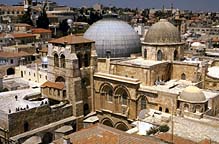
Holy Sepulchre Church, Jerusalem

Learn about Jesus Christ's death and resurrection |

Learn about His life and ministry |
Caiaphas the High Priest
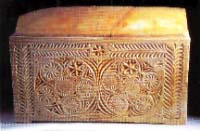
Ossuary of Caiaphas the High Priest
At a meeting of the religious leaders, Caiaphas said, "It is better for you that one man die for the people than the whole nation perish" (John 11:50). He was referring to the possible intervention of the Roman authorities, if Jesus' teaching should cause unrest. His words were prophetic in that Jesus did die for the people, all the people of the earth, as a sacrifice for sin.
Read the story of Christ's death
Following Jesus' crucifixion, Caiaphas continued to persecute the early church. He brought the apostles before the religious leaders and said to them, "We gave you strict orders not to teach in this Name. Yet you have filled Jerusalem with your teaching and are determined to make us guilty of this man's (Jesus') blood." Peter and the other apostles replied, "We must obey God rather then men" (Acts 5:28-29).
The Caiaphas family tomb was accidentally discovered by workers constructing a road in a park just south of the Old City of Jerusalem. Archaeologists were hastily called to the scene. When they examined the tomb they found 12 ossuaries (limestone bone boxes) containing the remains of 63 individuals. The most beautifully decorated of the ossuaries was inscribed with the name "Joseph son of (or, of the family of) Caiaphas." That was the full name of the high priest who arrested Jesus, as documented by Josephus (Antiquities 18: 2, 2; 4, 3). Inside were the remains of a 60-year-old male, almost certainly those of the Caiaphas of the New Testament. This remarkable discovery has, for the first time, provided us with the physical remains of an individual named in the Bible.
[Learn more about Caiaphas]
James, brother of Jesus Christ
 Have archaeologists discovered his ossuary (burial box)? Answer
Caesar Augustus
A great politician and administrator, Augustus ruled the Roman empire from 27 B.C.-A.D. 14. It was Augustus who issued the census decree that brought Mary and Joseph to Bethlehem, where Jesus was born (Luke 2:1-7). Augustus erected for himself a grand mausoleum in Rome, on the east bank of the Tiber River, one quarter mile northwest of the Roman Forum. The remains exist today in the middle of the Piazza Augusto Imperatore.It was 285 feet in diameter and 143 feet high, surmounted by a statue of the emperor. His ashes were placed in an urn in the center, while those of other members of the dynasty were place in urns in a corridor around a central cylinder. Although some of the urns were found in place by excavators, the ashes had long since disappeared.
[More about Ceasar Augustus / Read the story of Christ's birth ]
Tomb of the Patriarchs
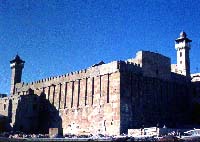 The Bible says that Sarah, Abraham, Isaac, Rebekah, Leah and Jacob were buried in Hebron, in a cave called the Cave of Machpelah, purchased by Abraham (Gen. 23).
Traditionally, this cave has been located below the Haram el-Khalil ("sacred precinct of the friend of the merciful One, God") in Hebron, today a Muslim mosque. References as early as the Hellenistic period (2nd century B.C.) testify that this is the authentic location of the burial place of the Patriarchs. The cave was explored by the Augustine Canons in 1119, at which time they claim to have found the bones of the Patriarchs.
Joseph, son of Jacob (grandson of Abraham)
Has Joseph's original tomb been found? Answer[Learn more more about Joseph]
Tombs of David and Solomon
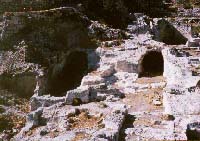
Tunnel tumbs
One exception to the normal custom was the burial of Uzziah. Since he was a leper, he was not buried with the other kings, but "near them in a field for burial that belonged to the kings, for people said, 'he had leprosy'" (2 Chr 26:23).
Interestingly, an inscription was found on the Mount of Olives in 1931 dating to the first century A.D. which reads, "Here were brought the bones of Uzziah, King of Judah—do not open." Evidently, because of his leprosy, Uzziah's bones were removed from the field belonging to the kings and transferred to yet a more remote location.
Cyrus the Great
Cyrus ruled the Persian empire from 559-530 B.C. He is best known for his capture of Babylon in 539 B.C. Already in the 8th century B.C. Isaiah predicted this defeat (Isaiah 45:1-3), and went on to say that Cyrus would "set my exiles free' (Isaiah 45:13). That Cyrus released the Jewish exiles from Babylon is not only documented in the Bible (2 Chronicles 36:22-23; Ezra 1:2-4), but also implied in the contemporary Cyrus Cylinder. This ancient record states, "I (Cyrus) gathered all their former inhabitants and returned to them their habitations."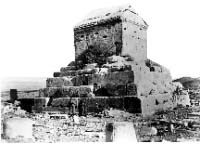 Cyrus
was buried in a simple gabled stone tomb outside his capital of
Pasargadae in modern Iran. According to the historian Strabo, this
inscription once graced the structure, "Oh man, I am Cyrus, the son of
Cambyses, who founded the empire of Persia, and was king of Asia. Grudge me not therefore this monument" (Geography xv.3.7).
Cyrus
was buried in a simple gabled stone tomb outside his capital of
Pasargadae in modern Iran. According to the historian Strabo, this
inscription once graced the structure, "Oh man, I am Cyrus, the son of
Cambyses, who founded the empire of Persia, and was king of Asia. Grudge me not therefore this monument" (Geography xv.3.7).Darius-I the Great
Darius I was king of the Persian empire from 522-486 B.C. He gave permission to renew the rebuilding of the Temple (Ezra 6:1-12), which had been discontinued for some 10 years.His is the first of three monumental tombs cut into a cliff near the Persian capital of Persepolis, Iran. The inscription on his tomb reads,
King Darius states: King, whoever you are, who may arise after me, protect yourself well from lies. Do not trust the man who lies. … Believe what I did and tell the truth to the people. Do not conceal (it). If you do not conceal these matters, but you do tell the people, may Ahura Mayda protect you. …There are three other tombs at the site, thought to be those of the Persian kings Xerxes (485-465 B.C.), Artaxerxes I (465-424 B.C.), and Darius II (423-405 B.C.). There are no accompanying inscriptions, however, to be certain of these identifications. Xerxes is the Ahasuerus of the book of Esther, the king whom Esther married. Ezra was a scribe (Ezra 7:6) and Nehemiah a cupbearer (Nehemiah 2:1) under Artaxerxes I. He authorized both Ezra and Nehemiah to return to Jerusalem, Ezra to carry out religious and judicial duties (Ezra 7:12-26), and Nehemiah to rebuild the city walls (Nehemiah 2:1-9). Darius II may be the Darius mentioned in Nehemiah 12:22, but this is not certain
source http://christiananswers.net

No comments:
Post a Comment