| Many of the people mentioned in the Bible are confirmed in sources outside the Bible. In the case of royalty, many times a likeness of the individual has been recovered. Over 50 persons named in the Old Testament are known outside the Bible, and we have likenesses of 12 of them. Some 27 people named in the New Testament are known from other records, with six likenesses surviving (four of them Roman emperors). Based on current knowledge of Biblical and Egyptian chronology, the best candidate for the pharaoh of the Exodus is Tuthmosis III, who ruled 1504-1450 B.C. We have many records from his reign, as well as this statuary (see photo) of the pharaoh himself. Likenesses have also been found of these Biblical figures: * Shishak, the Egyptian king who plundered the Temple during the reign of Rehoboam (1 Kings 14:25-26). * Jehu, king of Israel, who took power in a bloody coup; the only surviving likeness of a king of Israel or Judah (2 Kings 9:1-10:36). * Hazael, king of Aram, enemy of Israel (1 Kings 19:15, 17; 2 Kings 8:7-15, 28-29; 9:14-15; 10:32-33; 12:17-18; 13:3, 22, 24,25; Amos 1:4). * Tiglath-Pileser III, king of Assyria, who invaded Israel (2 Kings 18:19, 29; 16:7, 10; 1 Chronicles 5:6, 26; 2 Chronicles 28:20). * Sargon II, king of Assyria, who defeated Ashdod and completed the siege of Samaria and took Israelites into captivity (Isaiah 20:1). * Sennacherib, king of Assyria, who attacked Judah but was unable to capture Jerusalem (2 Kings 18:13-19:37). * Tirhakah, king of Egypt, who opposed Sennacherib (2 Kings 19:9). * Esarhaddon, king of Assyria, who succeeded his father Sennacherib (2 Kings 19:37). * Merodach-baladan, king of Babylon, whose messengers Hezekiah showed the royal treasury, much to the indignation of Isaiah (2 Kings 20:12-19). * Xerxes I, king of Persia, who made Esther his queen (Esther; Ezra 4:6). * Darius I, king of Persia, who allowed the returning exiles to rebuild the Temple in Jerusalem (Ezra 4:24-6:15; Haggai 1:1, 15). Also see: Have archaeologists found the tomb of Darius? [answer] * Augustus, Roman emperor, 27 B.C.-A.D. 14, when Jesus was born (Luke 2:1). * Tiberius, Roman emperor, A.D. 14-37, during Jesus' adulthood and crucifixion (Matthew 22:17, 21; Mark 12:14-17; Luke 3:1; 20:22-25; 23:2; John 19:12,15). * Claudius, Roman emperor, A.D. 41-54, who ordered the Jews to leave Rome (Acts 11:28; 17:7; 18:2). * Herod Agrippa I, ruler of Judea, A.D. 37-44, who persecuted the early church (Acts 12:1-23; 23:35). * Aretas IV, king of the Nabateans, 9 B.C.-A.D. 40, whose governor in Damascus attempted to arrest Paul (2 Corinthians 11:32). * Nero (referred to as Caesar in the New Testament), Roman emperor, A.D. 54-68, who Paul appealed to (Acts 25:11,12,21; 26:32; 28:19; Philippians 4:22). |
Monday, July 29, 2013
Have any likenesses been found of persons named in the Bible?

Have the burial sites of any people in the Bible been found?
Have the burial sites of any people in the Bible been found?
Throughout Bible lands there are numerous “traditional” tombs of various Biblical personages, sometimes several for one individual! In many cases, there is no historical or archaeological evidence to back up the identification. There are various instances where there is strong, if not certain, evidence for locating the burial site of a person, or persons, named in the Bible.Jesus Christ
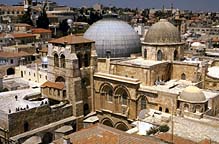
Holy Sepulchre Church, Jerusalem

Learn about Jesus Christ's death and resurrection |

Learn about His life and ministry |
Caiaphas the High Priest
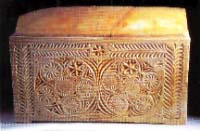
Ossuary of Caiaphas the High Priest
At a meeting of the religious leaders, Caiaphas said, "It is better for you that one man die for the people than the whole nation perish" (John 11:50). He was referring to the possible intervention of the Roman authorities, if Jesus' teaching should cause unrest. His words were prophetic in that Jesus did die for the people, all the people of the earth, as a sacrifice for sin.
Read the story of Christ's death
Following Jesus' crucifixion, Caiaphas continued to persecute the early church. He brought the apostles before the religious leaders and said to them, "We gave you strict orders not to teach in this Name. Yet you have filled Jerusalem with your teaching and are determined to make us guilty of this man's (Jesus') blood." Peter and the other apostles replied, "We must obey God rather then men" (Acts 5:28-29).
The Caiaphas family tomb was accidentally discovered by workers constructing a road in a park just south of the Old City of Jerusalem. Archaeologists were hastily called to the scene. When they examined the tomb they found 12 ossuaries (limestone bone boxes) containing the remains of 63 individuals. The most beautifully decorated of the ossuaries was inscribed with the name "Joseph son of (or, of the family of) Caiaphas." That was the full name of the high priest who arrested Jesus, as documented by Josephus (Antiquities 18: 2, 2; 4, 3). Inside were the remains of a 60-year-old male, almost certainly those of the Caiaphas of the New Testament. This remarkable discovery has, for the first time, provided us with the physical remains of an individual named in the Bible.
[Learn more about Caiaphas]
James, brother of Jesus Christ
 Have archaeologists discovered his ossuary (burial box)? Answer
Caesar Augustus
A great politician and administrator, Augustus ruled the Roman empire from 27 B.C.-A.D. 14. It was Augustus who issued the census decree that brought Mary and Joseph to Bethlehem, where Jesus was born (Luke 2:1-7). Augustus erected for himself a grand mausoleum in Rome, on the east bank of the Tiber River, one quarter mile northwest of the Roman Forum. The remains exist today in the middle of the Piazza Augusto Imperatore.It was 285 feet in diameter and 143 feet high, surmounted by a statue of the emperor. His ashes were placed in an urn in the center, while those of other members of the dynasty were place in urns in a corridor around a central cylinder. Although some of the urns were found in place by excavators, the ashes had long since disappeared.
[More about Ceasar Augustus / Read the story of Christ's birth ]
Tomb of the Patriarchs
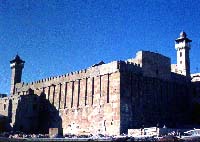 The Bible says that Sarah, Abraham, Isaac, Rebekah, Leah and Jacob were buried in Hebron, in a cave called the Cave of Machpelah, purchased by Abraham (Gen. 23).
Traditionally, this cave has been located below the Haram el-Khalil ("sacred precinct of the friend of the merciful One, God") in Hebron, today a Muslim mosque. References as early as the Hellenistic period (2nd century B.C.) testify that this is the authentic location of the burial place of the Patriarchs. The cave was explored by the Augustine Canons in 1119, at which time they claim to have found the bones of the Patriarchs.
Joseph, son of Jacob (grandson of Abraham)
Has Joseph's original tomb been found? Answer[Learn more more about Joseph]
Tombs of David and Solomon
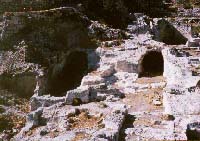
Tunnel tumbs
One exception to the normal custom was the burial of Uzziah. Since he was a leper, he was not buried with the other kings, but "near them in a field for burial that belonged to the kings, for people said, 'he had leprosy'" (2 Chr 26:23).
Interestingly, an inscription was found on the Mount of Olives in 1931 dating to the first century A.D. which reads, "Here were brought the bones of Uzziah, King of Judah—do not open." Evidently, because of his leprosy, Uzziah's bones were removed from the field belonging to the kings and transferred to yet a more remote location.
Cyrus the Great
Cyrus ruled the Persian empire from 559-530 B.C. He is best known for his capture of Babylon in 539 B.C. Already in the 8th century B.C. Isaiah predicted this defeat (Isaiah 45:1-3), and went on to say that Cyrus would "set my exiles free' (Isaiah 45:13). That Cyrus released the Jewish exiles from Babylon is not only documented in the Bible (2 Chronicles 36:22-23; Ezra 1:2-4), but also implied in the contemporary Cyrus Cylinder. This ancient record states, "I (Cyrus) gathered all their former inhabitants and returned to them their habitations."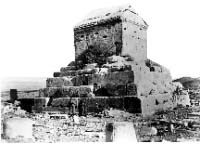 Cyrus
was buried in a simple gabled stone tomb outside his capital of
Pasargadae in modern Iran. According to the historian Strabo, this
inscription once graced the structure, "Oh man, I am Cyrus, the son of
Cambyses, who founded the empire of Persia, and was king of Asia. Grudge me not therefore this monument" (Geography xv.3.7).
Cyrus
was buried in a simple gabled stone tomb outside his capital of
Pasargadae in modern Iran. According to the historian Strabo, this
inscription once graced the structure, "Oh man, I am Cyrus, the son of
Cambyses, who founded the empire of Persia, and was king of Asia. Grudge me not therefore this monument" (Geography xv.3.7).Darius-I the Great
Darius I was king of the Persian empire from 522-486 B.C. He gave permission to renew the rebuilding of the Temple (Ezra 6:1-12), which had been discontinued for some 10 years.His is the first of three monumental tombs cut into a cliff near the Persian capital of Persepolis, Iran. The inscription on his tomb reads,
King Darius states: King, whoever you are, who may arise after me, protect yourself well from lies. Do not trust the man who lies. … Believe what I did and tell the truth to the people. Do not conceal (it). If you do not conceal these matters, but you do tell the people, may Ahura Mayda protect you. …There are three other tombs at the site, thought to be those of the Persian kings Xerxes (485-465 B.C.), Artaxerxes I (465-424 B.C.), and Darius II (423-405 B.C.). There are no accompanying inscriptions, however, to be certain of these identifications. Xerxes is the Ahasuerus of the book of Esther, the king whom Esther married. Ezra was a scribe (Ezra 7:6) and Nehemiah a cupbearer (Nehemiah 2:1) under Artaxerxes I. He authorized both Ezra and Nehemiah to return to Jerusalem, Ezra to carry out religious and judicial duties (Ezra 7:12-26), and Nehemiah to rebuild the city walls (Nehemiah 2:1-9). Darius II may be the Darius mentioned in Nehemiah 12:22, but this is not certain
source http://christiananswers.net
Is there any confirmation of Biblical events from written sources outside the Bible?
Is there any confirmation of Biblical events from written sources outside the Bible?

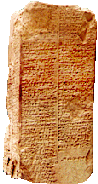
Ancient tablet listing the Sumerian kings
[More information] The Story of Adapa tells of a test for immortality involving food, similar to the story of Adam and Eve in the Garden of Eden. Sumerian tablets record the confusion of language as we have in the Biblical account of the Tower of Babel (Genesis 11:1-9). There was a golden age when all mankind spoke the same language. Speech was then confused by the god Enki, lord of wisdom. The Babylonians had a similar account in which the gods destroyed a temple tower and “scattered them abroad and made strange their speech.” |
How does archaeology conclusively demonstrate the Bible to be reliable and unique among all the holy books of world religions?
How does archaeology conclusively demonstrate the Bible to be reliable and unique among all the holy books of world religions?
 |
|
 Archaeological discoveries verify the historical reliability of the Old and New Testaments.
When compared to other religious books, the Bible is unique in that it is the oldest, as testified by the places, people, titles, and events mentioned in the Bible; and the language and literary formats used to compose the Bible. Many scholars today question the validity of Biblical accounts, supposedly based on the findings of archaeology. When the “discrepancies” are examined in detail, however it is found that the problems lie with the archaeology (i.e. misinterpretation of evidence, lack of evidence, or poor scholarship) and not with the Bible. How can archaeology prove helpful to someone seeking for truth to the basic questions about life?The discoveries of archaeology can be helpful in removing doubts that a person might have about the historical trustworthiness of the Bible. The miracles described, as well as the spiritual message, must be accepted on faith, which is the basis of our relationship with God. When the truth of Scripture is challenged by skeptics, archaeology can be used to demonstrate that the people, places, and events of the Bible are real.What archaeological discovery would you point to as the most convincing evidence for the Bible being God's Word?Any one discovery can be explained away as coincidence, or an alternative interpretation can be given to disassociate it from the Bible. It is the weight of a myriad of discoveries that demonstrates the Bible to be the Word of God.These discoveries fall into three categories:
|
In what ways have the discoveries of archaeology verified the reliability of the Bible?
In what ways have the discoveries of archaeology verified the reliability of the Bible?
Over the years there have been many criticisms leveled against the Bible concerning its historical reliability. These criticisms are usually based on a lack of evidence from outside sources to confirm the Biblical record. Since the Bible is a religious book, many scholars take the position that it is biased and cannot be trusted unless we have corroborating evidence from extra-Biblical sources. In other words, the Bible is guilty until proven innocent, and a lack of outside evidence places the Biblical account in doubt.This standard is far different from that applied to other ancient documents, even though many, if not most, have a religious element. They are considered to be accurate, unless there is evidence to show that they are not. Although it is not possible to verify every incident in the Bible, the discoveries of archaeology since the mid-1800s have demonstrated the reliability and plausibility of the Bible narrative.
Here are some examples:
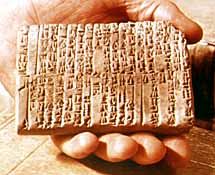 The discovery of the Ebla archive in northern Syria in the 1970s has shown the Biblical writings concerning the Patriarchs to be viable. Documents written on clay tablets from around 2300 B.C. demonstrate that personal and place names in the Patriarchal accounts are genuine. The name “Canaan”
was in use in Ebla, a name critics once said was not used at that time
and was used incorrectly in the early chapters of the Bible. The word tehom (“the deep”) in Genesis 1:2
was said to be a late word demonstrating the late writing of the
creation story. “Tehom” was part of the vocabulary at Ebla, in use some
800 years before Moses. Ancient customs reflected in the stories of the Patriarchs have also been found in clay tablets from Nuzi and Mari.
The discovery of the Ebla archive in northern Syria in the 1970s has shown the Biblical writings concerning the Patriarchs to be viable. Documents written on clay tablets from around 2300 B.C. demonstrate that personal and place names in the Patriarchal accounts are genuine. The name “Canaan”
was in use in Ebla, a name critics once said was not used at that time
and was used incorrectly in the early chapters of the Bible. The word tehom (“the deep”) in Genesis 1:2
was said to be a late word demonstrating the late writing of the
creation story. “Tehom” was part of the vocabulary at Ebla, in use some
800 years before Moses. Ancient customs reflected in the stories of the Patriarchs have also been found in clay tablets from Nuzi and Mari.- The Hittites were once thought to be a Biblical legend, until their capital and records were discovered at Bogazkoy, Turkey.
- Many thought the Biblical references to Solomon's wealth were greatly exaggerated. Recovered records from the past show that wealth in antiquity was concentrated with the king and Solomon's prosperity was entirely feasible.
- It was once claimed there was no Assyrian king named Sargon as recorded in Isaiah 20:1, because this name was not known in any other record. Then, Sargon's palace was discovered in Khorsabad, Iraq. The very event mentioned in Isaiah 20, his capture of Ashdod, was recorded on the palace walls. What is more, fragments of a stela memorializing the victory were found at Ashdod itself.
- Another king who was in doubt was Belshazzar, king of Babylon, named in Daniel 5. The last king of Babylon was Nabonidus according to recorded history. Tablets were found showing that Belshazzar was Nabonidus' son who served as coregent in Babylon. Thus, Belshazzar could offer to make Daniel “third highest ruler in the kingdom” (Dan. 5:16) for reading the handwriting on the wall, the highest available position. Here we see the “eye-witness” nature of the Biblical record, as is so often brought out by the discoveries of archaeology.
Top Ten Archaeological Discoveries of the Twentieth Century Relating to the Biblical World
Top Ten Archaeological Discoveries of the Twentieth Century Relating to the Biblical World
Keith
N. Schoville
|
|
This
article was published in Stone Campbell Journal, Vol. 4,
No. 1, and is published here with the kind permission of Dr. William
Baker, editor of the Stone Campbell Journal, and Dr. Schoville,
the author. Over the years I have always looked forward to a short
visit with Keith Schoville at the annual meetings of the Near East
Archaeological Society and the Society of Biblical Literature. We have added photographs to make the article of more interest to the general public. Photo credits are visible when you move your cursor over the photo. Visit the Stone Campbell Journal web page for information about subscriptions. |
Ten major archeological discoveries of the past century that are significant for understanding the world of the Bible are identified. For each find, a narrative of its discovery and the crucial information it unlocks is relayed, plus its connection to key biblical events or references. These ten discoveries illustrate the point that new facts about the Bible, its world and personalities, come through diligence in archeological research.Any list of the major archaeological discoveries of the last century of significance for understanding the world of the Bible must of necessity be arbitrary and based to a considerable degree on the selector's judgment; that is true of this list. Nevertheless, identifying these ten should arouse the interest of readers to the continuing work of archaeologists in the ancient Near East, including at least the eastern Mediterranean, Egypt, Israel, Jordan, Syria, Lebanon, Turkey, Iraq and Iran. We should be reminded, too, that the only new facts about the Bible and the world in which the events occurred, the personalities lived, and it was written come from archaeological research. The search for the past and the resultant discoveries are always subject to chance finds, so at any point in time it is possible for evidence to surface that brings a biblical figure or event out of the dust of the past and into the present through the recovery of a new text, inscription, or relic of antiquity.
1 THE DEAD SEA SCROLLS [1]
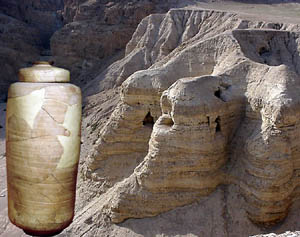 |
|
Cave
4 at Qumran and One of the Dead Sea Scroll Jars on Display at
the Amman Archaeological Museum in Jordan.
|
Subsequent investigations in the area of the cave of discovery ultimately led to the recovery of documents in a total of eleven caves and the excavation of a modest ruin nearby known as Khirbet (the ruin of) Qumran. All of this was occurring as the modern State of Israel was coming into existence, with all the political upheaval involved in that development. [2] As this century ends and a new one begins, efforts for a peaceful political settlement in the region continue and give signs of reaching fruition. In the meantime, scholars continue to study the multitude of fragments recovered and to attempt to assess their significance.
Among the more than eight hundred documents represented by whole scrolls, incomplete scrolls, and a myriad of fragments which have been recovered are complete copies or portions of all the books in the Hebrew Bible (our OT), except for the Book of Esther. These texts are older by at least a thousand years than any previous biblical texts written in Hebrew that we had prior to the discovery. They provide a window into the textual history of the OT prior to the closure of the canon. [3]
Besides copies of scriptural texts, from the caves in the Qumran area came sectarian documents that open a panorama on the obscure Jewish group apparently related to the production and deposition of the manuscripts. [4] This group was likely the Essenes, previously known from references to them in the writings of Flavius Josephus, Philo Judaeus, and Pliny the Elder. All the texts discovered, taken together, open a critical window into events in Palestine in the decades prior to and following the birth of Christ (although no NT texts were found among the scrolls) up to the time of the First Jewish Revolt against the Romans. The historical period of the Dead Sea Scrolls illuminates the environment in which Christianity developed in Palestine, the transformation of Judaism into Rabbinic Judaism in the aftermath of the First Revolt of the Jews against the Romans with the destruction of Jerusalem and its temple, and the context in which the canonization of Holy Scripture was progressing.
The Dead Sea Scrolls now reside mainly in the Shrine of the Book, a part of the Israel Museum in Jerusalem where they are on display. The Copper Scroll can be seen in the Archaeological Museum in Amman, Jordan. Many of the small fragments are housed in the Rockefeller Museum in East Jerusalem. Scholars work almost exclusively with photographs and microfilm of the fragments, however, and these are available to scholars at many of the major universities around the world. It is likely that researchers will still be at work on the scrolls fifty years hence. [5]
2 THE HOUSE OF DAVID INSCRIPTION
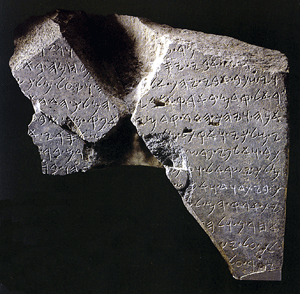 More
than a quarter of a century of excavations at Tel Dan in the north
of Israel at the foot of Mount Hermon produced little in the way of
written material. The excavations have been directed through the years
since 1966 by Dr. Avraham Biran, distinguised Israeli archaeologist.
Then on July 21, 1993, while work crews were preparing the site for
visitors, a broken fragment of basalt stone was uncovered in secondary
use in a wall. Surveyor Gila Cook glanced at the stone in the rays
of the afternoon sun and saw what looked like alphabetic letters.
On closer examination it turned out that, indeed, they had found an
inscribed stone.. The discovery was of a fragment of a large monumental
inscription, measuring about 32 cm. high and 22 cm. at its greatest
width. Apparently the stone had been purposely broken in antiquity.
It turned out that the stele fragment mentions King David's dynasty,
"the House of David." As the preparatory work for tourism proceeded,
two additional fragments of the stele were recovered in two separate,
disparate locations in June of 1994. The partially reconstructed text
reads as follows:
More
than a quarter of a century of excavations at Tel Dan in the north
of Israel at the foot of Mount Hermon produced little in the way of
written material. The excavations have been directed through the years
since 1966 by Dr. Avraham Biran, distinguised Israeli archaeologist.
Then on July 21, 1993, while work crews were preparing the site for
visitors, a broken fragment of basalt stone was uncovered in secondary
use in a wall. Surveyor Gila Cook glanced at the stone in the rays
of the afternoon sun and saw what looked like alphabetic letters.
On closer examination it turned out that, indeed, they had found an
inscribed stone.. The discovery was of a fragment of a large monumental
inscription, measuring about 32 cm. high and 22 cm. at its greatest
width. Apparently the stone had been purposely broken in antiquity.
It turned out that the stele fragment mentions King David's dynasty,
"the House of David." As the preparatory work for tourism proceeded,
two additional fragments of the stele were recovered in two separate,
disparate locations in June of 1994. The partially reconstructed text
reads as follows:1. [ ... ...] and cut [ ... ]
2. [ ... ] my father went up [against him when] he fought at [ ... ]
3. And my father lay down, he went to his [ancestors]. And the king of I [s-]
4. rael entered previously in my father's land. [And] Hadad made me king.
5. And Hadad went in front of me, [and] I departed from [the] seven [ ...-]
6. s of my kingdom, and I slew [seve]nty kin[gs], who harnessed thou[sands of cha-]
7. Riots and thousands of horsemen (or: horses). [I killed Jeho]ram son of [Ahab]
8. king of Israel, and [I] killed [Ahaz]iahu son of [Jehoram kin-]
9. g of the House of David. And I set [their towns into ruins and turned]
10. their land into [desolation ... ]
11. other [ ... and Jehu ru-]
12. led over Is[rael ... and I laid ]
13. siege upon [ ... ] [6]
The pavement and the wall where the fragments were found was laid at the end of the 9th or beginning of the 8th century BC, according to pottery fragments recovered in probes beneath the flagstone pavement. Since the fragment and the entire pavement was covered by the debris of the Assyrian destruction of Tiglath Pileser III, in 732 BC, it could not have been laid latter than that year.
The surmise is that Jehoash (798-782), grandson of Jehu, or Jehoash's son, Jeroboam II (793, co-regent 782-753), and more likely Jehoash, was the monarch who had this reminder of Aramaean domination smashed (2 Kgs 13:25). It is further assumed that Hazael (844/42-798?) was then king of Aram- Damascus, because Hazael fought against Jehoram of Israel and Ahaziah of Judah ( 2 Kgs 8:7-15, 28; 2 Chr 22:5). Hazael was followed by his son and successor, Ben-hadad III, early in the 8th century BC
The discovery provides an archaeological connection to the biblical references to the ruling dynasty established by King David approximately two centuries before the events that are mentioned in the inscription. It is the first mention of King David and the earliest mention of a biblical figure outside of the Bible. The discovery is of particular importance in the face of those scholars who were either skeptical or denied the historical existence of King David [7]
3 AMULET SCROLL [8]
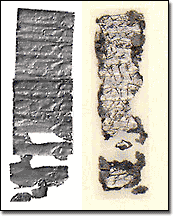 In
1979 Israeli archaeologist Gabriel Barkay, working with a group of
students from the Institute of Holy Land Studies (now Jerusalem University
College), excavated several tombs in Jerusalem on the "Shoulder of
Hinnom," on the southwestern slope of the Hinnom Valley adjacent to
the Scottish Presbyterian Church of St. Andrew. In one burial cave
a repository for grave goods was found, containing approximately 700
items, including burial gifts of pottery vessels, over 100 pieces
of silver jewelry, arrowheads, bone and ivory artifacts, alabaster
vessels, 150 beads and a rare, early coin. Among the silver items
was a rolled-up amulet bearing the tetragrammaton, the name of God
(the consonantal letters yod, he, waw, he), YHWH.
In
1979 Israeli archaeologist Gabriel Barkay, working with a group of
students from the Institute of Holy Land Studies (now Jerusalem University
College), excavated several tombs in Jerusalem on the "Shoulder of
Hinnom," on the southwestern slope of the Hinnom Valley adjacent to
the Scottish Presbyterian Church of St. Andrew. In one burial cave
a repository for grave goods was found, containing approximately 700
items, including burial gifts of pottery vessels, over 100 pieces
of silver jewelry, arrowheads, bone and ivory artifacts, alabaster
vessels, 150 beads and a rare, early coin. Among the silver items
was a rolled-up amulet bearing the tetragrammaton, the name of God
(the consonantal letters yod, he, waw, he), YHWH.The tomb dates to the end of the Davidic dynasty, approximately the seventh century BC. The silver amulet thus dates to the end of the seventh or early sixth century. The prayer-like inscription containing the divine name provides the oldest extra-biblical evidence for the name of God thus far archaeologically recovered in Jerusalem. The scripture passage on the amulet is from the Aaronic or priestly blessing found in Num 6:24-25. The owner apparently wore the inscribed, rolled-up silver amulet during his/her lifetime, and people felt it appropriate that such objects should accompany the owner in death as in life.
Of secondary interest is the fact that the evidence from the Shoulder of Hinnom tombs indicates a population in the Jerusalem area in the aftermath of the Babylonian destruction of the city. The evidence also indicates a certain level of wealth on the part of those buried in the tombs.
4 GALILEE BOAT [9]
A severe drought in 1985-86 brought the Sea of Galilee to unusually low levels, exposing large areas of the lakebed along the shoreline. Two brothers–Moshe and Yuval Lufan--from Kibbutz Ginnosar, near Tiberias along the northwest shore of the sea, discovered the remains of a 2,000 year old boat buried in the mud along the shore. Israeli archaeologist Shelley Wachsman, an expert in marine archaeology, examined the sunken boat in situ and was able to confirm that it was an ancient rather than a modern craft. His judgment was based on a construction technique used in antiquity in which the planks of the hull were edge-joined with mortise and tendon joints held together by wooden pegs. This was the first time an ancient boat had been discovered in the Sea of Galilee.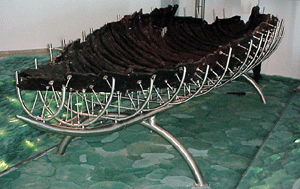 |
|
The
Galilee Boat on Permanent Display
at the Nof Ginosaur Museum. |
Evidence was found that the boat could be both sailed and/or rowed. Apparently the boat could accommodate four oarsmen plus a helmsman. It is estimated that the boat could hold some fifteen individuals, similar to the boats in which Jesus and his twelve disciples traveled across the sea (See Matt 8:18, 23-27, 9:1, 14:13- 14, 22-32, 15:39, 16:5; Mark 4;35-41, 5:18, 21, 6:32-34, 45-51, 8:9-10, 13-14; Luke 6:1, 8:22-25, 37, 40; John 6:16-21).
In recent years the boat, now preserved through the conservation efforts, has a permanent home in a specially constructed exhibit hall at Kibbutz Ginnosar. It has become a highlight for tourists visiting the Holy Land and a visual reminder of the Gentle Teacher from Galilee.
5 BARUCH BULLA [10]
Literally hundreds of Hebrew seals and seal impressions have been discovered in the last century and a half either in authorized archaeological excavations or by clandestine diggers; the results of the latter ending up in the hands of antiquities dealers, subsequently to come into the hands of collectors or of scholars. Hardened clay seal impressions are called "bullae" (sg., bulla). Bullae have survived in damp earth in a remarkable way.In biblical Israel, papyrus was the primary form of writing material. Once an official document was written, it would be rolled up, one end folded in one-third of the breadth and the opposite end similarly folded in. The document, now shortened by folding, was tied with a string and a lump of clay was impressed on the knotted string. Then the upper surface of the clay lump was impressed with the signet ring of the owner of the document or its writer. Such documents were stored in temple or palace archives, with the unbroken seal guaranteeing the validity of the document's contents.
The reason the clay bullae survived is that a conflagration that destroyed the building and the papyrus archive fired the clay sealings, making them practically indestructible. The evidence of the knotted cord to which the clay had been attached remains on the underside of the bullae.
Sometime during the 1970's, a bulla containing the stamp and name of the scribe of Jeremiah appeared on the antiquities market and was acquired by a collector, Dr. R. Hecht. He permitted Israeli archaeologist Nahman Avigad to publish the bulla, which came from an unidentified place, now thought to be the "burnt house" excavated by Yigal Shiloh. The bulla is now in the Israel Museum. It measures 17 by 16 mm, and is stamped with an oval seal, 13 by 11 mm. A single line borders the impression, and it is divided by double horizontal lines into three registers bearing the following inscription:
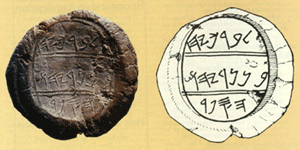 lbrkyhw
Belonging to Berechiah
lbrkyhw
Belonging to Berechiahbn nryhw son of Neriah
hspr the scribe.
The script used is the pre-exilic ancient Hebrew linear script, rather than the post-exilic script adopted by Jews from the contemporary Aramaic script. Reading the Hebrew from right to left, the first letter, Heb (l), is the preposition "to, belonging to," and the last three letters, heb. (yhw)is a shortened form of the name of God, Heb. (yhwh), the shortened form was likely pronounced "yahu." Baruch's name means "Blessed of the Lord (Yahweh)."
This bulla was without doubt from the impression of Baruch ben Neriah , the scribe who wrote to the dictation of the prophet Jeremiah (Jer 36:4). Dr. Avigad expressed his personal feelings as he worked with the Baruch Bulla as having the feeling "of personal contact with persons who figure prominently in the dramatic events in which the giant figure of Jeremiah and his faithful follower Baruch were involved at a most critical time preceding the downfall of Judah." [11]
Avigad also published a seal bearing the inscription "Belonging to Seraiah (ben) Neriah." Seriah was the "chief chamberlain" in the court of King Zedekiah (Jer 51:59). [12] He accompanied the king to Babylon, and he carried a written oracle from the prophet Jeremiah looking for the ultimate destruction of Babylon, which he was to read aloud on his arrival in the city, then to throw the document into the Euphrates (Jer 59:64). Seriah ben Neriah was the brother of Baruch ben Neriah, and both were close friends of the prophet Jeremiah.
6 OSSUARY OF CAIAPHAS [13]
A dump truck accidentally smashed through the roof of a tomb in November, 1990, during some work in the Jerusalem Peace Forest, leading to the discovery of the ossuary which contained the bones of the High Priest in the time of Jesus. The Jerusalem Peace Forest is located on the southwest side of old Jerusalem, across the Hinnom Valley from Mt. Zion. Here, on the slope of the hills is a large cemetery from the late Second Temple era (1st century BC to 1st century AD). Rock-cut burial chambers used by Jews in this period contained typically four burial niches, shelves cut into the sides of the chamber; ossuaries are also characteristic of and unique to the period.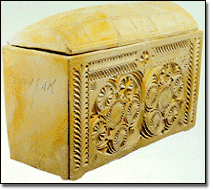 An
ossuary is a stone bone box, used for secondary burials. Initially
the body is laid to rest in a burial niche. After decomposition, the
bones were collected and placed in an ossuary, making the burial niche
available for a subsequent burial. Tombs belonged to families, so
subsequent burials were normal. Two of a dozen ossuaries in the tomb
contained a form of the name Qafa', or Caiaphas. Several of the ossuaries
were decorated with traditional carved rosettes, zig-zag patterns,
and other designs. The most intricately carved ossuary was decorated
with two circles each containing five rosettes, and twice carved into
an undecorated side appears the name, "Yehosef bar Qafa'" (Joseph
son of Caiaphas). The ossuary contained the remains of six people:
two infants, a child aged two to five, a boy aged 13 to 18, an adult
female and a man about 60 years old. The latter are believed to be
the bones of Caiaphas, before whom Jesus was brought for questioning
(Matt 26:3, 57; Luke 3:2; John 11:49, 18:13, 14, 24, 28; Acts 4:6)
[14]
An
ossuary is a stone bone box, used for secondary burials. Initially
the body is laid to rest in a burial niche. After decomposition, the
bones were collected and placed in an ossuary, making the burial niche
available for a subsequent burial. Tombs belonged to families, so
subsequent burials were normal. Two of a dozen ossuaries in the tomb
contained a form of the name Qafa', or Caiaphas. Several of the ossuaries
were decorated with traditional carved rosettes, zig-zag patterns,
and other designs. The most intricately carved ossuary was decorated
with two circles each containing five rosettes, and twice carved into
an undecorated side appears the name, "Yehosef bar Qafa'" (Joseph
son of Caiaphas). The ossuary contained the remains of six people:
two infants, a child aged two to five, a boy aged 13 to 18, an adult
female and a man about 60 years old. The latter are believed to be
the bones of Caiaphas, before whom Jesus was brought for questioning
(Matt 26:3, 57; Luke 3:2; John 11:49, 18:13, 14, 24, 28; Acts 4:6)
[14]7 PONTIUS PILATE INSCRIPTION
 |
|
Replica
of Pilate Inscription on Display at Caesarea.
|
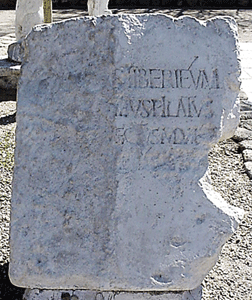
Although Pilate is also mentioned in Josephus, Philo and Tacitus and coins issued during his governance exist, inscriptional evidence for Pilate was discovered in Italian excavations at Caesarea Maritima in 1961. Antonio Frova, director of the excavations, found a dedicatory stone that bore a three-line inscription: Tiberieum/[Pon]tius Pilatus/[Praef]ectus Iuda[eae], "Tiberius [the Roman emperor of the period]/Pontius Pilate/Prefect of Judea." The stone, in secondary use in the theatre at Caesarea, had been shaped to fit its new use and in the process some of the inscription had been mutilated, although it was easily reconstructed. The inscription not only confirms the historicity of Pilate, it clarifies the title that he bore as governor. It is now on display in the Israel Museum in Jerusalem.
8 EKRON INSCRIPTION [15]
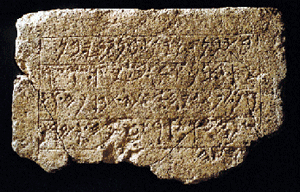
In 1993, archaeologists Seymour Gitin of the W. F. Albright Institute of Archaeological Research and Trude Dothan of Hebrew University of Jerusalem, were in their thirteenth and final season of excavations at Tel Miqne in Israel. They had long suspected that Tel Miqne was the site of one of the main cities of the Philistine pentapolis, specifically biblical Ekron (Josh 13:3, plus 23 other references in the OT). Then a royal dedicatory inscription carved into a slab of limestone dramatically confirmed the place name, along with the names of five of its rulers, and two of them are specifically mentioned in the Bible.The inscription was found in a destruction layer attributed to the Babylonian conquest dating to 603 BC It was within a 186 by 124 foot structure, considered a temple complex. The complex followed the design of known Assyrian palaces, and one section contained a sanctuary with a stone pavement; the inscription had fallen in the destruction to the pavement. The five lines of the inscription reads:
1. The temple which he built, 'kysh (Achish, Ikausu) son of Padi, son of
2. Ysd son of Ada, son of Ya'ir, ruler of Ekron,
3. For Ptgyh his lady. May she bless him, and
4. protect him, and prolong his days, and bless
5. his land.
 Both
Ikausu and his father, Padi, are known from Assyrian records as kings
of Ekron. Sennacherib's annals mention Padi, in connection with the
Assyrian campaign against the region in 701 BC that included the siege
of King Hezekiah's Jerusalem. Padi also payed his taxes to his Assyrian
overlord in 699 BC, as recorded on a royal clay sealing, indicating
a contribution of a light talent of silver, about 67.5 pounds. Ikausu
is numbered among twelve regional kings who transported building materials
to Nineveh for the construction of the palace of Esarhaddon (680-669
BC) and also in a list of kings who assisted Ashurbanipal in his first
campaign against Egypt in 667 BC The other three kings in this Philistine
dynasty, Ysd, Ada and Yair, are otherwise unattested.
Both
Ikausu and his father, Padi, are known from Assyrian records as kings
of Ekron. Sennacherib's annals mention Padi, in connection with the
Assyrian campaign against the region in 701 BC that included the siege
of King Hezekiah's Jerusalem. Padi also payed his taxes to his Assyrian
overlord in 699 BC, as recorded on a royal clay sealing, indicating
a contribution of a light talent of silver, about 67.5 pounds. Ikausu
is numbered among twelve regional kings who transported building materials
to Nineveh for the construction of the palace of Esarhaddon (680-669
BC) and also in a list of kings who assisted Ashurbanipal in his first
campaign against Egypt in 667 BC The other three kings in this Philistine
dynasty, Ysd, Ada and Yair, are otherwise unattested.The goddess Ptgyh may be an unknown Philistine deity or, more likely, by reading the damaged fourth letter of the name as "nun=n", as Pt[n]yh. [16] This would be read as "Potnia," meaning "mistress" or "lady," the formal title used for various goddesses in ancient Greek The goddess behind the title was likely Asherah, a Semitic deity, since the other known Philistine deities bear clearly Semitic names: Dagon and Ba`al-zebul. The inscription thus helps confirm that the Philistines, whose origins were in Caphtor=Crete, in biblical tradition (See Amos 9:7), had largely assimilated to Canaanite culture in the centuries between their arrival and the dedication of the temple of Ekron.
9 MOUNT EBAL ALTAR [17]
This is a controversial pick, because the interpretation of the discovery is far from settled; nevertheless, Israeli archaeologist Adam Zertal, who came across the ruins during an archaeological survey of the tribal region of Manasseh in 1980, still adheres to his interpretation. He went on to excavate the site located on Mt Ebal, the mountain from which Joshua pronounced the curses, [18] lying opposite Mt. Gerizim, the mountain of blessings, and separated by the valley in which the ruins of ancient Shechem lie near modern Nablus. He determined to excavate the site because in the survey he had found a great quantity of pottery sherds lying around the large pile of stones. The sherds dated to Iron Age I, ca. 1220-1000 BC, the period in which Israelites apparently settled in Canaan, as well as the period of the Judges. Further, though many Iron Age I sites were discovered in the survey, this was the only such site on Mt. Ebal.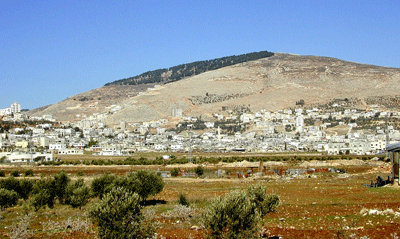 |
|
Photo
of Mount Ebal by Todd Bolen - BiblePlaces.Com
|
10 UGARIT [19]
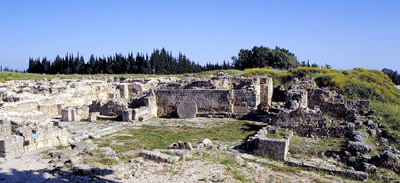
Tell Ras Shamra contains the ruins of an ancient city known as Ugarit. The name was known, although the location was not, from references in the Amarna letters of Egypt and the political correspondence from ancient Mari prior to the discovery in 1928. The major excavator was Claude F. A. Schaeffer followed after his retirement by several other French directors. Excavations still continue in the face of growing urbanization both at the tell and at a seaside site a few kilometers away, Ras Ibn Hani.
 |
|
Some
of the Excavations of Tell Ras Shamra.
Photo by Ferrell Jenkins, May 2002. |
Apart
from the architecture and artifacts of a wealthy, cosmopolitan center
recovered, the significance of Ugarit is in the recovery of thousands
of cuneiform tablets, written in several languages current in international
circles of the day, but particularly a heretofore unknown language
now bearing the name Ugaritic, after the site. When deciphered, the
cuneiform signs used for writing were discovered to be based on the
Semitic alphabet rather than on the syllabic signs of Mesopotamia.
Even more important were the contents of the documents written in
Ugaritic. Some were recovered from palace complexes and were primarily
administrative and economic texts, opening a window on the international
diplomacy and trade current before the city's destruction and demise
c. 1180 BC. Others were recovered from temple complexes, including
the legends and myths of Ugarit. Two legendary epics focus on ancient
kings, Keret and Danel. Mythological texts recount the stories of
Baal and Anath, Kathir-and-Khasis, El (the patriarch of the gods),
Athtart, Mot (the god of sterility and death), Yam (the sea monster
god) and others.
The myths
and legends of Ugarit permit us to glimpse the conceptions of the
supernatural that infused Canaanite life and thought and to observe
their cultic rites and practices. The Canaanites were polytheists,
and their gods were primarily deified aspects of nature. What we have
is an unbiased view into the culture which dominated the land of Canaan
into which the Israelites came, permitting us to understand the religious
and cultural environment that in part Israel conquered and in part
which conquered Israel. The Ugaritic literature and material continue
to provide a rich source for comparative studies with biblical texts,
including the Hebrew language, sociological, economic, monarchical,
and religious areas. [20]source //www.biblicalstudies.info
Saturday, July 27, 2013
How Muslims Defend Islam: Their Silly Arguments
How Muslims Defend Islam: Their Silly Arguments
Muslims use an endless list of fallacious and silly arguments in their defence of indefensible Islam. Here is a list of those:
‘Out of Context’ Argument
When one raises questions about verses of the Quran or Muhammad’s actions from the hadith, all Muslims—be it mullahs or educated moderate ones—parrot only one thing in defence: ‘You are talking out of context’, ‘please find out under what circumstances Muhammad did so’, ‘there must be some reason for that’ and so on. But they themselves will never try to find out those contexts or circumstances under which Muhammad did so many malicious things, or nonsensical or violence-inciting verses were revealed. And when you show them the context of verses from the tafsirs, which often make Islam appear even more evil and atrocious, they immediately change tune to claim that ‘this verse is allegorical’ and on the worst scenario, they would say ‘this verse is sarcastic’. Just imagine that the creator of the universe is talking in allegorical or sarcastic terms for guiding humanity through His divine scripture.
‘Circular Logic’ Argument
Whenever one asks Muslims to prove their religion and prophet to be true, all of them answer in a similar and very absurd and illogical way. They explain:
Muslim: Muhammad is a true prophet because the Quran says so.
Inquirer: What is the evidence that the Quran is true and divine?
Muslim: The Quran is true because Allah says so.
Inquirer: How do you to be certain that Allah is the true God and the Quran is His divine words?
Muslim: Allah is the true God because Muhammad said so.
Inquirer: And how do you know what Muhammad was true?
Muslim: Muhammad is true because the Quran says so.
This is called circular logic, proving something from its own source. It is like saying: I am the God, and the evidence for this is that I am saying so. Remember, no one trust something that the claimer himself says. He has to prove himself either with evidences or with reason. The source of the Quran and Allah is only one and that source is Muhammad. Muhammad himself is claiming everything, and there is no evidence whatsoever that those claims are true and credible. Any thug and imposter can claim something in these ways. That doesn’t make that claim true. Not only that, whenever Muslims try to validate or justify any instruction or law of the Quran or of Islam—like the benefit of veil or growing beard or anything else—they give Quranic evidence in support of their claims, even to non-believers of the Quran. How foolish these behaviours are!
‘This is Not Islam’ Argument
Whenever pointed to evil acts committed by a Muslim, Islamic group or Islamic nation in the name of Islam, another excuse Muslims offer in Islam’s defence is: ‘This is not Islam’, ‘This has nothing to do with Islam’, ‘Nowhere does Islam command one to do so’. Be it 9/11 or 26/11 terror attacks or a condemnable act like the shooting of young girl Malala Yousufzai by Pakistani Taleban, their answer is always the same: “This is not Islam” to which is routinely added another excuse, “This must a ploy of the Jews and the West to defame Islam”.
Whenever something bad is done by Muslims, Muslims countries—immediately Muslims will blindly say the following:
If this is not Islam, then what is Islam, where is it followed, and who are following it?
‘Everyone cannot understand the Quran’ Argument
Whenever one criticizes or asks questions about errors and contradictions in the Quran, Muslims repeat the reply like parrots that not everyone can understand the depth and wisdom of the Quran, many people get misled by reading the Quran itself. If ask back: What other meanings can one derive from verses of Quran, which misleads the readers also? Or who will decide who is actually misled by reading the Quran, who is not? Is it the non-believers of the Quran or the Muslims themselves? Questions such as these would lead Muslims to a point, when they will have no further answers to offer. And at such point, they will say: “This kind of questions will only weaken your faith and eventually would lead you to great loss”.
‘Islam is also a socio-political Religion’ Argument
Muslims claims that Islam teaches everything in life, from sex acts to politics. When they are pointed to any unconscionable or violent command in the Quran and Hadiths, for example, some Islamic teachings that deprive individuals of his/her rights or teachings that are perilous to certain person or gender, then immediately they try to show some social benefit of that law or teaching, while completely ignoring its detrimental aspects. This argument is a shameless trick used by Muslims to hide the Islamic blunder, which Muslims often make—some of them consciously, others plagiarizing subconsciously. This argument is a significant camouflage against the truth that Islam is a political cult.
‘Scientific laws may change but not the Quran’ Argument
On one hand, Muslims claim that science is not comparable to Islam, which is absolute and eternal divine truth, while science keeps changing. On the other hand, they try hard to show that Islam is compatible with science, and they keep trying to prove that there are all kinds of sciences in the Quran and Hadiths. At the other end, science never tries to claim compatibility with the Quran; science works on its own way. Therefore, Muslims by trying hard to show compatibility of the Quran with science unwittingly puts science above, Islam below, because nobody will try to show compatibility of something with another which is inferior. Similarly, they claim that the teachings of the Quran are above everything else, yet they send their children to school to learn science, which they consider backward and inferior to Islam, to knowledge of the Quran and Hadith. Who could be greater fools than Muslims, who knowingly send their children to learn a false, inferior and momentary thing? They claim all other scriptures like the Bible, Torah, Gita and others are either corrupted or not at all divine, and simultaneously they claim that Muhammad is predicted in those scriptures. None can bigger idiots than those, who make such self-contradictory claims?
‘Allah knows best & It’s Allah wish’ Argument
In a debate or discussion with Muslims or mullahs, when one asks a critical question about Islam for which they have no answers, they will immediately end the discussion with words like: “It is Allah’s wish”, “Allah knows best”. This means that they come to engage in debate with certitude when they know little in their own admission. If one comes to engage in a discussion or a debate and says, he doesn’t know, it is Allah who knows, then what is the point of discussion with him? I have debated with hundreds of such Muslims. Their answers were all the same and ended with same sentence: “It is Allah wish”. For example, when I ask them: Why did Allah take six days to create the heaven and earth in spite of the power of ‘Kun Fayakun’ and being omnipotent, they answered, “It is Allah’s wish”. Whenever I ask Muslims, why Allah asked Muhammad to marry a six-year-old girl and what Allah proved thus, their only answer is: “It is Allah’s wish”. When I asked, how a child would be treated on Judgment Day, who was born in an infidel family and died within 2-3 years of his/her birth, they answered: “Allah knows best”. When I asked them, how the population after Adam and Eve grew when they only had two sons, Abel and Cain, no sister, they answered: “Allah’s know. We are not supposed to know everything and cannot question him and his wisdom.” If Islam don’t have the answer for ‘wherefrom and how we have come to existence’, isn’t it foolish to believe Islam’s saying about where we heading to.
They win debates by saying only, ‘Allah knows”, and “Allah has every answer”. Thus, they are saved from answering crucial question leaving the critics unable to debate further, because Muslims can’t contact Allah for the answer and Allah will not answer before the Judgment Day.
‘Even hearing such things is sin’ Argument
Another very cunning and dishonest ploy Muslims employ in defense of Islam is that they leave a discussion or a debate by saying: “Oh God! We can’t even hear this sort of denigration about a great person like our beloved Prophet Muhammad” or “it is a sin to hear such defamation of our prophet”. This is a very great misdemeanor to defend Islam and Muhammad. If one is defaming my father, I am not supposed to leave the place saying, “I cannot even hear such things against a great personality like my father”. If I have confidence in the integrity of father, I will clear the doubts of the person raising such criticisms against my father’s character with refutation of the accusation with substantive evidence. Only if I have no confidence in my father’s character, I may leave the place with lame excuse like Muslims do regarding the weakness of Muhammad’s character, although it will be wiser for me to ask for evidence from the person so that I may enlighten myself about some unknown weakness that my father might have had. After all, we are only humans prone to erring.
On the existence of Allah and the sanctity of Islam, Muslims are always afraid of losing their faith and try to avoid such discussions at any cost, while atheists or agnostics are never afraid of such things. This is because, whatever beliefs Muslims cherish are not based on concrete reason or evidence but on superstition or blind faith. Faith is nothing but hope, and hope is the only lie that never loses its credibility. Atheists and agnostics live on evidence and reason while believers live on faith and superstition. That’s why the former don’t have controversies and contradictions among them and are open to discussion and doubt anything, even their cherished thoughts about the world. Edifice based on faith and superstition can’t be defended by reasoned argument, but only threats and violence, which followers of blind-faith religions have employed copious throughout history. So says Bertrand Russell: “Persecution is used in theology, but not in arithmetic, because in arithmetic there is knowledge, but in theology there are only opinions.”
‘This life is just a Test’ Argument
Whenever faced with questions like – why there is so much suffering and diseases in the world, why there are earthquakes, floods, cyclones and other natural disasters, from which even the followers of the Quran and Hadiths are not spared – Muslims readily claim that ‘This life is only a test’. For them, earthly life is temporal, does not deserve any serious attention and the earth is only an examination hall. Yet, they pay so much importance to their unimportant life on earth that they carry out the most horrendous acts like the 9/11 massacre in USA, 26/11 massacre in Mumbia, Madrid bombings, Boston blasts, shooting the little girl Malala, and such. In the examination hall only, their prophet had more than a dozen of wives and married a six-year-old girl (Aisha) when he was aged 50.
‘Islam is the fastest-growing religion’ Argument
In the defence of Islam, another frequent made vacuous claim of Muslims is: ‘Islam is the fastest growing religion’ in the world. So, it must be the truest religion on earth. First, this argument is completely fallacious. Islam is the fastest-growing religion does not mean that is the true or truest religion, because truth has nothing to do with majority, nor should it be judged on the basis of numbers. If this is so, then idolatry was truest religion 2000 years ago, because the world’s 99% people were polytheistic at that time. Believers of Hinduism were larger than Muslims over the greater part of Islam’s 1400-year history (until the last century), so Hinduism was true religion, Islam was false until then. Today, Christianity is believed by more people than Islam; so Christianity must be true, Islam is false. Or once, Christianity was the fastest-growing religion in earth; so Christianity was the true religion during those times.
Muslims are polyphiloprogenitive, i.e. they breed faster than others peoples. But that is the characteristic of all poor and uneducated people in any nations. Prior to Copernicus and Galileo, almost everyone agreed that the Earth was flat and the universe was geocentric. This consensus of virtually every member of human race did not make this belief true. As Bertrand Russell said: The fact that an opinion has been widely held is no evidence whatever that it is not utterly absurd; indeed in view of the silliness of the majority of mankind, a widespread belief is more likely to be foolish than sensible.”
It is totally fallacious on the part of Muslims when they claim Islam to be true because it is most popular, like saying “thousands of people convert to Islam; so it must be true”. Hitler said, if a lie is repeated often enough and long enough, it would come to be perceived as truth.
Other similar Muslim claims are:
‘This was the custom of that time’ Argument
When one points out the evil practices and violence of Muhammad, Muslims come up with another excuse that ‘This was the custom of the time’. No matter you tell them, ‘Muhammad had slaves’, ‘Muhammad had concubines’, ‘He married a six-year-old girls, ‘He killed people’ or ‘He waged wars’, their answer would always be similar and simple, ‘This was the custom of the time’ or ‘War was sometime necessary to establish peace’. But when you ask them to produce example of another saints or prophets who did so, you will find them mum. Remember, morality is not a time-dependent, place-dependent, or person-dependent variable. Whatever is wrong for one person, it is wrong for another; whatever is wrong in on time, it is wrong for any time; whatever is wrong is one place, it is wrong in another place. Another question is that: Did Muhammad come to reform the social evils of his or to be a part of it? If he could not reform the evils of the contemporary society, instead practiced those evils, then why should one follow him?
‘It is our fault, not Islam’s’ Argument
Today, very few Muslims follow certain laws of Islam, like, keeping beard, say prayers five times a day, reproduce prolifically, and learning from Islamic teachers or mullahs. When one asks them: why don’t you follow Islam properly if it is a simple and beneficial religion, then you will definitely hear this answer: ‘This is our fault.” “If we cannot follow Islam, it is our fall, not of Allah; Allah has given us guidance, now it is up to us whether or not we follow it’. If such a vast majority of Muslims fails to comply with the Islamic laws, then we are obliged to say that Islam has failed as a religion.
‘The Error is in the translation’ Argument
When the contradictions, absurdities, or the violent verses of the Quran are pointed out, Muslims will ask aggressively: “Do you know Arabic?” When the non-Muslim replies, “No”, they triumphantly say, “You have to read it in original Arabic to understand it fully”, or “These verses/words are not there in the original Arabic Quran”, or, “The exact meaning of the verses of the Quran is lost in the translation”, or “There are many fake translations of the Qur’an to malign Islam” etc. With this, Western critics generally become silent. If critics ask them to name a translation that they read to understand the Quran properly, they would hesitate to tell any name, but if you press them, they would name those same translations which they were denying to inaccurate. So, the conclusion is that they can use any translations for their understanding of the Quran properly, but if the critics discover errors and contradictions in the same translation, it becomes inaccurate.
Now the essentiality of reading the Quran in Arabic to understand it accurately, the question is: How many Muslims have read the Qur’an in original Arabic? Since the majority of the Muslims are not Arabs, they also rely on translations. When they have not read it in Arabic or they even don’t know anything about Arabic, how could they claim that it needs to be read in Arabic to understand correctly? Therefore, the language argument is a dishonest Muslim tactic to defend the many problems inherent in the Quran. Language is no barrier for find truth, as those who translated must have done so with extreme care and analysis and consultation from various sources. Furthermore, if they think those translations are wrong then why there is no protest against those fake translations, like the way Muslims generally do for any criticism and denigration against Islam and Muhammad. And how many Muslims scholars and Muslims read the Bible in Greek or Aramaic, the Torah in Hebrew or the Gita in Sanskrit before they criticize those scriptures, which they are most active at.
If the translations of the Quran by greatest scholars of Arabic language and Islam are full of errors, then who in this world has understood the Quran accurately? Why God has created the Quran in such a language and expressions that is difficult to grasp and interpret by the most proficient in Arabic? Though the purpose is to guide the entire population of the world, while Arabic is the language of humankind’s most treasured sacred book that is understood by small population in the world. Did Allah want to spend half of our lives in learning a language and then understanding His divine instruction?
‘Islam is a misunderstood religion’ Argument
Another excuse used by Muslim apologists that aims to sanitize Islam from the practices of its followers when they are pointed to the evil, atrocities and outrageous activities of Muslims all the globe, like bomb blasts in the mosques in Pakistan, Iraq or any other, shooting by Taliban to a young girl (Malala), attacking and bombing schools of young children by the Taleban in Afghanistan and other shameful terrorist activities all over the world, and very old men, often clerics, marrying underage girls, they reply: ‘Islam is a misunderstood religion’, ‘those Muslims misunderstand Islam’. Such claims are made against by those devout members of Islamic organizations, who spend their entire lives learning about Islam. The irony is that the people who make the claims have very little knowledge of or even know nothing about Islam. For them, Islam comprises of only those soft outer layer such as shahada, prayers, fasting, zakat, hajj, and avoiding sins like adultery, alcohol and pork consumption. There are tens of millions of Muslims, whose understanding of Islam is limited to that polished image. They are the Muslims, who truly misunderstand Islam. They never read the Quran and Hadith to understand that their Islam is only a miniscule part of the whole gamut of Islam, which is purely a political game, set up by Muhammad to rule the world and bring the world under Islamic imperialism.
A religion that can be so extensively misunderstood for fourteen hundred years by its own followers is certainly not worth following, nor respect.
Almost every Muslim will make the outrageous claim that they are not true Muslims, they are not following Islam. Muslims of one sect claims the Muslim of another Islamic sect that ‘they are not Muslims’; ‘they are not following Islam truly’. Who truly follow Islam is a completely dark concept. Even if there some people who correctly follow Islam, their number must be miniscule or nearly non-existent.
It takes more exploration and learning to discover the inherent harder core of Islam, where the importance of jihad and rejection of the others become more highlighted. Unfortunately, by the time Muslims reach that level of knowledge, they have already committed themselves to the service of Allah and their brain damage is complete. They become the violent and outrageous Muslims. A few others desert Islam.
There was never a time when Islam had a one distinct picture that Muslims could see with clarity and agree on. From the beginning, Islam was destined to have multiple interpretations. The Quran addresses issues in a vague, not concise style that sets the ground for multiple interpretations. Muslims are told that they can find in the Quran all the information they need; but when they open the book, they find nothing but repeated vagueness. Instead of coming to the obvious conclusion that the Quran is nonsense, they try to extract any interpretation to support whatever imagination they have in mind. Seeking refuge in Hadith does not help, because different Hadiths give different pictures of Islam depending on which ones you want to believe.
Let us not forget that Islam, from its inception, has been used as a political tool to subjugate the masses. Today’s Muslims have the same problem in understanding Islam as their ancestors did over the past fourteen centuries. Muslims, who are biased to their own political views, can usually manage to find some kind of support in the Quran or Sunna.
Only 24 years after Mohammed’s death, a group of Muslims broke into Uthman’s house; the third rightly-guided Caliph and the Prophet dearest companion and son-in-law, and murdered him while he was reading the Quran. Those Muslims did not think for a second they were committing a murder, but were utterly convinced they were practicing jihad for the sake of Allah. Their judgment was based on their understanding of the Quran and Sunna. On the other hand, Uthman’s supporters, who also based their judgment on the Quran and Sunna, believed those men were murderers and deserved to be killed.
Caliph Ali, the fourth rightly-guided Caliph and also the Prophet dearest companion and son-in-law, and his supporters of Sahaba (Mohammed’s companions) were engaged for five years defending the Islamic state against their adversaries, who were also Sahaba. Both sides fought the war while holding the Quran and shouting “Allahu Akbar”, as they slaughtered each other for the sake of Allah. More recently, when the Muslim nations were divided over Iraq’s invasion of Kuwait, both sides produced mountains of evidence, all based on sharia sources to prove that they were right and the other side was wrong or even committed kufr and deserves the death penalty!
A religion that can be so misunderstood for fourteen hundred years is certainly not worth following.
‘Red Herring’ Argument
This is one of the most common fallacies Muslims often make. It means whenever you point out an evil or an error of Islam, they would highlight the evil of other religions, instead of clarifying the criticism raised against Islam or the Quran. They present this fallacy as if you are an apologist of that religion, which they use as red herring. They don’t understand that highlighting evils committed by others does not dissipate theirs. When I raised the issue of polygamy of Muhammad, every Muslim shot back: ‘so what, even Krishna had several thousand wives’. What is interesting is that they often assert and believe that Ramayana and Mahabharata are only myths, yet they won’t refrain from highlighting those mythical stories to defend Muhammad, a real person, just to hide their own disgrace. If I point out that how can defend the Prophet by citing mythical stories from the Ramayana and Mahabharata, they often call me an apologist of Hinduism. Once I asked a Muslim why Muhammad fought so many wars, the person immediately retorted: “so what about the war of Mahabharata was also fought; Kanishka, a Buddhist, also waged wars and killed so many people. Then I asked him two questions: Is Mahabharata a real story and Was Kanishka a prophet of God? Then the person became quiet. In the first place, they are ignorant of the fact that highlighting evils of others does not justify the evils of their own. While debating, they rationalize as if Islam and other faiths are to have the same standard; they are not supposed to stand and fall together.
‘This Hadith is not authentic’ Argument
This argument is perhaps the last defence Muslims employ to save Islam. There are thousands of moral, scientific, and logical errors in the book of Hadiths, which itself is more than sufficient evidence to prove that Islam is a evil cult and Muhammad was a cruel imposter. But when questions raised on the integrity of Islam and Muhammad due to those numerous indefensible Hadiths, the sustainers of Islam come up with another explanation that those Hadiths (sayings and deeds of Muhammad as mentions in the books of Hadiths) are Da’eef (not authentic). On what basis they declare those Hadiths to be unauthentic is completely unexplained and cagey. If those Hadiths were not correct, then why the Muhadiths wrote those outrageous and incorrect things, still a nightmare for Islamic apologists? The acme of misdemeanor is that if those Hadiths are going to remain there even it is not authentic, so that they can bring them into play when needed.
‘Conspiracy of the West and Jews’ Argument
Whatever atrocities Muslims do all over the world, Muslims generally blame the conspiracy of the West and the Jews for those acts. Be it the 9/11 terrorists attacks, or the Madrid bombings or the 26/11 Mumbai massacre, Muslims tend to accuse anyone but Muslims for those evil acts. Even after the confession of Osama Bin Laden, Muslims still claimed that the 9/11 attacks were an inside job of the US government or committed by the Jews. Those, who commit those atrocities, Muslims believe, are actually agents of the West or Israel, who had taken proper training in Islam. All these they do are aimed at defaming Islam. This sort of lies released by renowned Muslim clerics or leaders eventually reaches the mouth of every Muslim, who learns it by heart, and like a parrot, speaks without any reasoning whatsoever. Why would the West and Israel try to defame Islam? Why they don’t carry out the same campaign against other religions, such as Hinduism or Buddhism? What they would achieve from these efforts? Would a person burn his own house in order to blame his neighbour? And if they undergo proper training in Islamic scripture just to malign Islam, why don’t they get inspiration from their learning the Quran, Hadiths and Sira, and become devout Muslim? Why Allah leaves them uninspired even after their reading the Quran? These are questions Muslims are afraid to ask. From the last question in this list arise Muslims’ fallacious argument discussed next.
‘Allah’s gives Hidayah as He wishes’ Argument
When one asks a Muslim: Why do so many Muslims leave Islam, especially after gaining good knowledge of Islam and the Quran? Or, why there are so many non-Muslim scholars of Arabic and Islamic literature who, despite having very deep knowledge of Islam, never embrace Islam? They would retort that Allah gives Hidayah, whomever He wills. They argue that Allah did not bestow Hidayah even upon Muhammad’s loving uncle and protector. Such arguments are nothing but fallacious defence to hide the evil and treachery of Muhammad. The reason why Muhammad’s uncle did not accept him as a prophet can be another. His uncle Abu Taleb did not only deeply love him, but also swore to protect him when the Meccan expressed their desire to harm Muhammad for his insulting their religion and customs. Yet, Muslims will never reflect on why such a loving uncle would refuse to believe Muhammad’s prophetic claim, or why Allah will not give guidance to such a devoted and loving protector of His beloved apostle? Logically, if there was only one person Allah decided to give guidance, it should have been his uncle Abu Taleb. It seems Allah provide guidance to only those, who blindly trust Muhammad’s words.
Other Arguments
Muslims use more tricks in the defence of Islam. Whenever they are face with some Islamic duty, which are weird or difficult to follow for moral or practical reasons, they make all kinds of groundless classifications to justify their inability to follow them. Suppose, they are face with modern-day reality, where they must embrace Bid’dah (innovation), they classify it into two types—namely Bid’dah-e-Husna and Bid’dah-e-Zalala. When faced with their duty of engaging in Jihad, they classify it as Jihad-e-Nafs and Jihad Amr. But, there are such descriptions in the Quran and Hadith.
When one criticizes Islam, they demand for his/her qualification, when for such one issues, one require no specific qualification is required other than their own logic and conscience to be able to judge right and wrong, to tell sinner and saint apart, to separate good from evil. Yet, Muslims themselves can go on criticizing every other religion as per their wish.
When an ex-Muslim is able to show a Muslim the unsavory truth of Islam and convince him to leave Islam, Muslims accuse that new apostate must be an idiot and ignorant of true Islam or must have been forced to leave Islam. Actually those accusations apply to themselves most perfectly as they are the real ignorants of Islam and the victim of the greatest lie of the universe. Moreover, force and persecution is the weapon of Islam, of Muslims, not of the liberals because Islam legally mandates the killing of apostate.
With advancement of knowledge and technology with time, Muslims innovate new justifications to defend their weird and irrational beliefs. Most recently, they innovated the excuse that Islam mandate debate in open forum with physical presence, not in writing on websites, blogs or emails. This they claim because they know well that no sensible critic would debate with Muslims on Islamic issues in front of a Muslim audience, who are ever ready to kill anybody on the slightest of criticism of Islam. So, this is nothing but a cowardly way to defend their indefensible ideology. If anything, debating on internet can be far more feasible, comfortable, cheap, authentic and intellectual than any debate with physical appearance. Debating face to face can be threatening; people can use shriek, sophism, chicanery or demagogy to win the debate.
Muslims always react with shriek and insolence when one says something critical of Islam. It is well known that Muslims almost nothing substantive to support their claim that Islam is a true religion and Muhammad was a true prophet of God. Muslims only can hurl abuses and threats to silence the critics of Islam. Shrieking and stridency is their weapon to support their illogical and evil cult. If their religion is founded to truth, they would defend it with reason and logical arguments, not with threats and persecution. It seems their Allah did not provide brains or their religion didn’t provide them grounds to defend their claims. Else, they need not behave like wild beasts when people criticize Islam; they can shut the critics with logical arguments and refutations.
If a people in a society do evil things, like sacrificing young children and engage in killing and plundering of opponent sects, and assume that those evil deeds are worship of God, without any inclination to listen to anything about their rituals and beliefs, and are ready to kill anyone who say anything against their (evil) beliefs, just like Muslims do, then can you tell me any method to guide them to right path. Remember, open scrutiny is the only way to separate the right from the wrong. No criticism no rectification.
Bertrand Russell asserts: “Thoughts are not ‘free’ when legal penalties are incurred by the holding or not holding of certain opinions, or by giving expression to one’s belief or lack of belief on certain matters.” And when there is no freedom of thought, criticism is not tolerated, and then no reformation or purification is expected. Those who use threats, not logical arguments, are not only pauper of evidence but also intellectually impotent and ethically wimp, who depend on the means of others. Muslims fit that bill perfectly, as they use threats to suppress the critics of Islam and voices of truth. If they were on the right path, they would defeat them with the weapon of reason and ample rational substantiation in support of their claims. Just because they have no rational grounds to defend their superstitious, illogical and weird claims, they are so intolerant and ready to persecute one at the slightest of criticism against Islam and Muhammad.
As far as Muslims’ fanatical attitude regarding Islam is concerned, the Great Philanthropist, Philosopher, Mathematician, Logician and Educationist Sir Bertrand Russell’s following words most fitting:
The opinions that are held with passion are always those for which no good ground exists; indeed the passion is the measure of holder’s lack of rational conviction. Opinions in politics and religion are almost always held passionately.”
‘…the problem with the world today is ignorant are cocksure and intelligent are full of doubts.’
Muslims keeps blabbering about truth, greatness and miracles of their faith, but when questioned about basis of their rock-solid confidence in Islam, about what miracles they have seen in Islam, they can comes up with nothing convincing. I have asked this question to thousands of Muslims. Most of them failed to tell me anything and when some of them come up with answers, those appear silly or ridiculous.
I concur with Ali Sina’s statement that “Muslims put off their brains with their shoes and sandals and stand blindly behind an illiterate Imam who barks the Quranic verses without understanding even a single letter of it.” The Islamic ills affecting Muslims is chronic, which will take a long, long time to be cured. It can only be accelerated by their study of Islam patiently and with an open mind. There are a lot to know about Islam, judge everything by listening to both sides of arguments—all with a rational mind, and only then can Muslims realize what is true about their faith.
“He, who decides a case without hearing the other side, even if he decides justly, cannot be considered just.”
God will not punish anyone of us for using our brain to ask logical questions about anything we believe or even for questioning God’s existence, at least until His existence has been founded on concrete evidence. But Muhammad and his Islam intimidate Muslims against using your brains concerning his claims. Muslims are turned so morally down, dejected, downhearted and depressed that they have no moral courage to question anything about Islam than blinding believing each and everything Muhammad, the 7th-century pedophile, looter, liar, lustful misogynist and narcissist said and base their moral founds on the same. He turned Muslims into zombies, who have lost God’s biggest gifts them—their brain and rationality—thanks to Muhammad lure for them of big-bosom houris in Islamic heaven and the fear of roasting and toasting in hell. No matter how qualified they are academically, how many certificates and diplomas they may have, they are prone to utter nothing but rubbish in the matter of religious beliefs. There are honored professionals among Muslims, such chartered accountants, doctors, and engineers, but end result is all the same—they generally remain devoid of reason, when it comes to their faith. Just as Bertrand Russell has written (Sceptical Essays): “When a man adds up an account, he is much more likely to make a mistake in his favour than to his detriment; and when a man reasons, he is more apt to incur fallacies which favours his wishes than such as thwart them.”
SOURCE: http://www.faithfreedom.org
‘Out of Context’ Argument
When one raises questions about verses of the Quran or Muhammad’s actions from the hadith, all Muslims—be it mullahs or educated moderate ones—parrot only one thing in defence: ‘You are talking out of context’, ‘please find out under what circumstances Muhammad did so’, ‘there must be some reason for that’ and so on. But they themselves will never try to find out those contexts or circumstances under which Muhammad did so many malicious things, or nonsensical or violence-inciting verses were revealed. And when you show them the context of verses from the tafsirs, which often make Islam appear even more evil and atrocious, they immediately change tune to claim that ‘this verse is allegorical’ and on the worst scenario, they would say ‘this verse is sarcastic’. Just imagine that the creator of the universe is talking in allegorical or sarcastic terms for guiding humanity through His divine scripture.
‘Circular Logic’ Argument
Whenever one asks Muslims to prove their religion and prophet to be true, all of them answer in a similar and very absurd and illogical way. They explain:
Muslim: Muhammad is a true prophet because the Quran says so.
Inquirer: What is the evidence that the Quran is true and divine?
Muslim: The Quran is true because Allah says so.
Inquirer: How do you to be certain that Allah is the true God and the Quran is His divine words?
Muslim: Allah is the true God because Muhammad said so.
Inquirer: And how do you know what Muhammad was true?
Muslim: Muhammad is true because the Quran says so.
This is called circular logic, proving something from its own source. It is like saying: I am the God, and the evidence for this is that I am saying so. Remember, no one trust something that the claimer himself says. He has to prove himself either with evidences or with reason. The source of the Quran and Allah is only one and that source is Muhammad. Muhammad himself is claiming everything, and there is no evidence whatsoever that those claims are true and credible. Any thug and imposter can claim something in these ways. That doesn’t make that claim true. Not only that, whenever Muslims try to validate or justify any instruction or law of the Quran or of Islam—like the benefit of veil or growing beard or anything else—they give Quranic evidence in support of their claims, even to non-believers of the Quran. How foolish these behaviours are!
‘This is Not Islam’ Argument
Whenever pointed to evil acts committed by a Muslim, Islamic group or Islamic nation in the name of Islam, another excuse Muslims offer in Islam’s defence is: ‘This is not Islam’, ‘This has nothing to do with Islam’, ‘Nowhere does Islam command one to do so’. Be it 9/11 or 26/11 terror attacks or a condemnable act like the shooting of young girl Malala Yousufzai by Pakistani Taleban, their answer is always the same: “This is not Islam” to which is routinely added another excuse, “This must a ploy of the Jews and the West to defame Islam”.
Whenever something bad is done by Muslims, Muslims countries—immediately Muslims will blindly say the following:
- Iran, Afghanistan, Saudi Arabia’s political and social fallacies has nothing to do with real Islamic country.
- The Taliban’s destruction of Buddhist antiquities has nothing to do with real Islam.
- The Taliban shot fourteen years old Malala Yousufzai for promoting girls’ education in Pakistan and killing six polio vaccinators of Pakistan from UN have nothing to do with real Islam.
- The forcible conversion of helpless Christians in Indonesia has nothing to do with real Islam.
- The genocide being perpetrated in Sudan by the Islamists in Khartoum has nothing to do with real Islam.
- Bomb-blasts in Mosques of Pakistan, Iran and Iraq; has nothing to do with Islam.
- The unwillingness of the Saudi authorities to allow women to drive has nothing to do with real Islam.
- The sectarian violence in Pakistan between Sunni and Shiite has nothing to do with real Islam.
- The practice of female genital mutilation by Muslims all over North Africa, Middle East, Pakistan, Indonesia etc. have nothing to do with real Islam.
- Having sex with slave girls in Saudi Arabia has nothing to do with real Islam
- Women oppression and inequality with men has nothing to do with real Islam.
- The decapitations of the inhabitants of entire villages by jihadists in Algeria have nothing to do with real Islam.
- Acts of terror committed frequently around the world in the name of Islam have nothing to do with real Islam.
- The Hadiths depicting Muhammad (pbuh) as a pedophilic, murderous, thief have nothing to do with real Islam.
- The verses in the Quran and Hadiths justifying the slaughter of the Banu Qurayza by Allah’s Apostle (pbuh) have nothing to do with real Islam.
If this is not Islam, then what is Islam, where is it followed, and who are following it?
‘Everyone cannot understand the Quran’ Argument
Whenever one criticizes or asks questions about errors and contradictions in the Quran, Muslims repeat the reply like parrots that not everyone can understand the depth and wisdom of the Quran, many people get misled by reading the Quran itself. If ask back: What other meanings can one derive from verses of Quran, which misleads the readers also? Or who will decide who is actually misled by reading the Quran, who is not? Is it the non-believers of the Quran or the Muslims themselves? Questions such as these would lead Muslims to a point, when they will have no further answers to offer. And at such point, they will say: “This kind of questions will only weaken your faith and eventually would lead you to great loss”.
‘Islam is also a socio-political Religion’ Argument
Muslims claims that Islam teaches everything in life, from sex acts to politics. When they are pointed to any unconscionable or violent command in the Quran and Hadiths, for example, some Islamic teachings that deprive individuals of his/her rights or teachings that are perilous to certain person or gender, then immediately they try to show some social benefit of that law or teaching, while completely ignoring its detrimental aspects. This argument is a shameless trick used by Muslims to hide the Islamic blunder, which Muslims often make—some of them consciously, others plagiarizing subconsciously. This argument is a significant camouflage against the truth that Islam is a political cult.
‘Scientific laws may change but not the Quran’ Argument
On one hand, Muslims claim that science is not comparable to Islam, which is absolute and eternal divine truth, while science keeps changing. On the other hand, they try hard to show that Islam is compatible with science, and they keep trying to prove that there are all kinds of sciences in the Quran and Hadiths. At the other end, science never tries to claim compatibility with the Quran; science works on its own way. Therefore, Muslims by trying hard to show compatibility of the Quran with science unwittingly puts science above, Islam below, because nobody will try to show compatibility of something with another which is inferior. Similarly, they claim that the teachings of the Quran are above everything else, yet they send their children to school to learn science, which they consider backward and inferior to Islam, to knowledge of the Quran and Hadith. Who could be greater fools than Muslims, who knowingly send their children to learn a false, inferior and momentary thing? They claim all other scriptures like the Bible, Torah, Gita and others are either corrupted or not at all divine, and simultaneously they claim that Muhammad is predicted in those scriptures. None can bigger idiots than those, who make such self-contradictory claims?
‘Allah knows best & It’s Allah wish’ Argument
In a debate or discussion with Muslims or mullahs, when one asks a critical question about Islam for which they have no answers, they will immediately end the discussion with words like: “It is Allah’s wish”, “Allah knows best”. This means that they come to engage in debate with certitude when they know little in their own admission. If one comes to engage in a discussion or a debate and says, he doesn’t know, it is Allah who knows, then what is the point of discussion with him? I have debated with hundreds of such Muslims. Their answers were all the same and ended with same sentence: “It is Allah wish”. For example, when I ask them: Why did Allah take six days to create the heaven and earth in spite of the power of ‘Kun Fayakun’ and being omnipotent, they answered, “It is Allah’s wish”. Whenever I ask Muslims, why Allah asked Muhammad to marry a six-year-old girl and what Allah proved thus, their only answer is: “It is Allah’s wish”. When I asked, how a child would be treated on Judgment Day, who was born in an infidel family and died within 2-3 years of his/her birth, they answered: “Allah knows best”. When I asked them, how the population after Adam and Eve grew when they only had two sons, Abel and Cain, no sister, they answered: “Allah’s know. We are not supposed to know everything and cannot question him and his wisdom.” If Islam don’t have the answer for ‘wherefrom and how we have come to existence’, isn’t it foolish to believe Islam’s saying about where we heading to.
They win debates by saying only, ‘Allah knows”, and “Allah has every answer”. Thus, they are saved from answering crucial question leaving the critics unable to debate further, because Muslims can’t contact Allah for the answer and Allah will not answer before the Judgment Day.
‘Even hearing such things is sin’ Argument
Another very cunning and dishonest ploy Muslims employ in defense of Islam is that they leave a discussion or a debate by saying: “Oh God! We can’t even hear this sort of denigration about a great person like our beloved Prophet Muhammad” or “it is a sin to hear such defamation of our prophet”. This is a very great misdemeanor to defend Islam and Muhammad. If one is defaming my father, I am not supposed to leave the place saying, “I cannot even hear such things against a great personality like my father”. If I have confidence in the integrity of father, I will clear the doubts of the person raising such criticisms against my father’s character with refutation of the accusation with substantive evidence. Only if I have no confidence in my father’s character, I may leave the place with lame excuse like Muslims do regarding the weakness of Muhammad’s character, although it will be wiser for me to ask for evidence from the person so that I may enlighten myself about some unknown weakness that my father might have had. After all, we are only humans prone to erring.
On the existence of Allah and the sanctity of Islam, Muslims are always afraid of losing their faith and try to avoid such discussions at any cost, while atheists or agnostics are never afraid of such things. This is because, whatever beliefs Muslims cherish are not based on concrete reason or evidence but on superstition or blind faith. Faith is nothing but hope, and hope is the only lie that never loses its credibility. Atheists and agnostics live on evidence and reason while believers live on faith and superstition. That’s why the former don’t have controversies and contradictions among them and are open to discussion and doubt anything, even their cherished thoughts about the world. Edifice based on faith and superstition can’t be defended by reasoned argument, but only threats and violence, which followers of blind-faith religions have employed copious throughout history. So says Bertrand Russell: “Persecution is used in theology, but not in arithmetic, because in arithmetic there is knowledge, but in theology there are only opinions.”
‘This life is just a Test’ Argument
Whenever faced with questions like – why there is so much suffering and diseases in the world, why there are earthquakes, floods, cyclones and other natural disasters, from which even the followers of the Quran and Hadiths are not spared – Muslims readily claim that ‘This life is only a test’. For them, earthly life is temporal, does not deserve any serious attention and the earth is only an examination hall. Yet, they pay so much importance to their unimportant life on earth that they carry out the most horrendous acts like the 9/11 massacre in USA, 26/11 massacre in Mumbia, Madrid bombings, Boston blasts, shooting the little girl Malala, and such. In the examination hall only, their prophet had more than a dozen of wives and married a six-year-old girl (Aisha) when he was aged 50.
‘Islam is the fastest-growing religion’ Argument
In the defence of Islam, another frequent made vacuous claim of Muslims is: ‘Islam is the fastest growing religion’ in the world. So, it must be the truest religion on earth. First, this argument is completely fallacious. Islam is the fastest-growing religion does not mean that is the true or truest religion, because truth has nothing to do with majority, nor should it be judged on the basis of numbers. If this is so, then idolatry was truest religion 2000 years ago, because the world’s 99% people were polytheistic at that time. Believers of Hinduism were larger than Muslims over the greater part of Islam’s 1400-year history (until the last century), so Hinduism was true religion, Islam was false until then. Today, Christianity is believed by more people than Islam; so Christianity must be true, Islam is false. Or once, Christianity was the fastest-growing religion in earth; so Christianity was the true religion during those times.
Muslims are polyphiloprogenitive, i.e. they breed faster than others peoples. But that is the characteristic of all poor and uneducated people in any nations. Prior to Copernicus and Galileo, almost everyone agreed that the Earth was flat and the universe was geocentric. This consensus of virtually every member of human race did not make this belief true. As Bertrand Russell said: The fact that an opinion has been widely held is no evidence whatever that it is not utterly absurd; indeed in view of the silliness of the majority of mankind, a widespread belief is more likely to be foolish than sensible.”
It is totally fallacious on the part of Muslims when they claim Islam to be true because it is most popular, like saying “thousands of people convert to Islam; so it must be true”. Hitler said, if a lie is repeated often enough and long enough, it would come to be perceived as truth.
Other similar Muslim claims are:
- Muhammad is most influential person in history as per Michael Hart’s “The 100”.
- The Quran is the most widely read book.
- Muhammad is the most common name.
‘This was the custom of that time’ Argument
When one points out the evil practices and violence of Muhammad, Muslims come up with another excuse that ‘This was the custom of the time’. No matter you tell them, ‘Muhammad had slaves’, ‘Muhammad had concubines’, ‘He married a six-year-old girls, ‘He killed people’ or ‘He waged wars’, their answer would always be similar and simple, ‘This was the custom of the time’ or ‘War was sometime necessary to establish peace’. But when you ask them to produce example of another saints or prophets who did so, you will find them mum. Remember, morality is not a time-dependent, place-dependent, or person-dependent variable. Whatever is wrong for one person, it is wrong for another; whatever is wrong in on time, it is wrong for any time; whatever is wrong is one place, it is wrong in another place. Another question is that: Did Muhammad come to reform the social evils of his or to be a part of it? If he could not reform the evils of the contemporary society, instead practiced those evils, then why should one follow him?
‘It is our fault, not Islam’s’ Argument
Today, very few Muslims follow certain laws of Islam, like, keeping beard, say prayers five times a day, reproduce prolifically, and learning from Islamic teachers or mullahs. When one asks them: why don’t you follow Islam properly if it is a simple and beneficial religion, then you will definitely hear this answer: ‘This is our fault.” “If we cannot follow Islam, it is our fall, not of Allah; Allah has given us guidance, now it is up to us whether or not we follow it’. If such a vast majority of Muslims fails to comply with the Islamic laws, then we are obliged to say that Islam has failed as a religion.
‘The Error is in the translation’ Argument
When the contradictions, absurdities, or the violent verses of the Quran are pointed out, Muslims will ask aggressively: “Do you know Arabic?” When the non-Muslim replies, “No”, they triumphantly say, “You have to read it in original Arabic to understand it fully”, or “These verses/words are not there in the original Arabic Quran”, or, “The exact meaning of the verses of the Quran is lost in the translation”, or “There are many fake translations of the Qur’an to malign Islam” etc. With this, Western critics generally become silent. If critics ask them to name a translation that they read to understand the Quran properly, they would hesitate to tell any name, but if you press them, they would name those same translations which they were denying to inaccurate. So, the conclusion is that they can use any translations for their understanding of the Quran properly, but if the critics discover errors and contradictions in the same translation, it becomes inaccurate.
Now the essentiality of reading the Quran in Arabic to understand it accurately, the question is: How many Muslims have read the Qur’an in original Arabic? Since the majority of the Muslims are not Arabs, they also rely on translations. When they have not read it in Arabic or they even don’t know anything about Arabic, how could they claim that it needs to be read in Arabic to understand correctly? Therefore, the language argument is a dishonest Muslim tactic to defend the many problems inherent in the Quran. Language is no barrier for find truth, as those who translated must have done so with extreme care and analysis and consultation from various sources. Furthermore, if they think those translations are wrong then why there is no protest against those fake translations, like the way Muslims generally do for any criticism and denigration against Islam and Muhammad. And how many Muslims scholars and Muslims read the Bible in Greek or Aramaic, the Torah in Hebrew or the Gita in Sanskrit before they criticize those scriptures, which they are most active at.
If the translations of the Quran by greatest scholars of Arabic language and Islam are full of errors, then who in this world has understood the Quran accurately? Why God has created the Quran in such a language and expressions that is difficult to grasp and interpret by the most proficient in Arabic? Though the purpose is to guide the entire population of the world, while Arabic is the language of humankind’s most treasured sacred book that is understood by small population in the world. Did Allah want to spend half of our lives in learning a language and then understanding His divine instruction?
‘Islam is a misunderstood religion’ Argument
Another excuse used by Muslim apologists that aims to sanitize Islam from the practices of its followers when they are pointed to the evil, atrocities and outrageous activities of Muslims all the globe, like bomb blasts in the mosques in Pakistan, Iraq or any other, shooting by Taliban to a young girl (Malala), attacking and bombing schools of young children by the Taleban in Afghanistan and other shameful terrorist activities all over the world, and very old men, often clerics, marrying underage girls, they reply: ‘Islam is a misunderstood religion’, ‘those Muslims misunderstand Islam’. Such claims are made against by those devout members of Islamic organizations, who spend their entire lives learning about Islam. The irony is that the people who make the claims have very little knowledge of or even know nothing about Islam. For them, Islam comprises of only those soft outer layer such as shahada, prayers, fasting, zakat, hajj, and avoiding sins like adultery, alcohol and pork consumption. There are tens of millions of Muslims, whose understanding of Islam is limited to that polished image. They are the Muslims, who truly misunderstand Islam. They never read the Quran and Hadith to understand that their Islam is only a miniscule part of the whole gamut of Islam, which is purely a political game, set up by Muhammad to rule the world and bring the world under Islamic imperialism.
A religion that can be so extensively misunderstood for fourteen hundred years by its own followers is certainly not worth following, nor respect.
Almost every Muslim will make the outrageous claim that they are not true Muslims, they are not following Islam. Muslims of one sect claims the Muslim of another Islamic sect that ‘they are not Muslims’; ‘they are not following Islam truly’. Who truly follow Islam is a completely dark concept. Even if there some people who correctly follow Islam, their number must be miniscule or nearly non-existent.
It takes more exploration and learning to discover the inherent harder core of Islam, where the importance of jihad and rejection of the others become more highlighted. Unfortunately, by the time Muslims reach that level of knowledge, they have already committed themselves to the service of Allah and their brain damage is complete. They become the violent and outrageous Muslims. A few others desert Islam.
There was never a time when Islam had a one distinct picture that Muslims could see with clarity and agree on. From the beginning, Islam was destined to have multiple interpretations. The Quran addresses issues in a vague, not concise style that sets the ground for multiple interpretations. Muslims are told that they can find in the Quran all the information they need; but when they open the book, they find nothing but repeated vagueness. Instead of coming to the obvious conclusion that the Quran is nonsense, they try to extract any interpretation to support whatever imagination they have in mind. Seeking refuge in Hadith does not help, because different Hadiths give different pictures of Islam depending on which ones you want to believe.
Let us not forget that Islam, from its inception, has been used as a political tool to subjugate the masses. Today’s Muslims have the same problem in understanding Islam as their ancestors did over the past fourteen centuries. Muslims, who are biased to their own political views, can usually manage to find some kind of support in the Quran or Sunna.
Only 24 years after Mohammed’s death, a group of Muslims broke into Uthman’s house; the third rightly-guided Caliph and the Prophet dearest companion and son-in-law, and murdered him while he was reading the Quran. Those Muslims did not think for a second they were committing a murder, but were utterly convinced they were practicing jihad for the sake of Allah. Their judgment was based on their understanding of the Quran and Sunna. On the other hand, Uthman’s supporters, who also based their judgment on the Quran and Sunna, believed those men were murderers and deserved to be killed.
Caliph Ali, the fourth rightly-guided Caliph and also the Prophet dearest companion and son-in-law, and his supporters of Sahaba (Mohammed’s companions) were engaged for five years defending the Islamic state against their adversaries, who were also Sahaba. Both sides fought the war while holding the Quran and shouting “Allahu Akbar”, as they slaughtered each other for the sake of Allah. More recently, when the Muslim nations were divided over Iraq’s invasion of Kuwait, both sides produced mountains of evidence, all based on sharia sources to prove that they were right and the other side was wrong or even committed kufr and deserves the death penalty!
A religion that can be so misunderstood for fourteen hundred years is certainly not worth following.
‘Red Herring’ Argument
This is one of the most common fallacies Muslims often make. It means whenever you point out an evil or an error of Islam, they would highlight the evil of other religions, instead of clarifying the criticism raised against Islam or the Quran. They present this fallacy as if you are an apologist of that religion, which they use as red herring. They don’t understand that highlighting evils committed by others does not dissipate theirs. When I raised the issue of polygamy of Muhammad, every Muslim shot back: ‘so what, even Krishna had several thousand wives’. What is interesting is that they often assert and believe that Ramayana and Mahabharata are only myths, yet they won’t refrain from highlighting those mythical stories to defend Muhammad, a real person, just to hide their own disgrace. If I point out that how can defend the Prophet by citing mythical stories from the Ramayana and Mahabharata, they often call me an apologist of Hinduism. Once I asked a Muslim why Muhammad fought so many wars, the person immediately retorted: “so what about the war of Mahabharata was also fought; Kanishka, a Buddhist, also waged wars and killed so many people. Then I asked him two questions: Is Mahabharata a real story and Was Kanishka a prophet of God? Then the person became quiet. In the first place, they are ignorant of the fact that highlighting evils of others does not justify the evils of their own. While debating, they rationalize as if Islam and other faiths are to have the same standard; they are not supposed to stand and fall together.
‘This Hadith is not authentic’ Argument
This argument is perhaps the last defence Muslims employ to save Islam. There are thousands of moral, scientific, and logical errors in the book of Hadiths, which itself is more than sufficient evidence to prove that Islam is a evil cult and Muhammad was a cruel imposter. But when questions raised on the integrity of Islam and Muhammad due to those numerous indefensible Hadiths, the sustainers of Islam come up with another explanation that those Hadiths (sayings and deeds of Muhammad as mentions in the books of Hadiths) are Da’eef (not authentic). On what basis they declare those Hadiths to be unauthentic is completely unexplained and cagey. If those Hadiths were not correct, then why the Muhadiths wrote those outrageous and incorrect things, still a nightmare for Islamic apologists? The acme of misdemeanor is that if those Hadiths are going to remain there even it is not authentic, so that they can bring them into play when needed.
‘Conspiracy of the West and Jews’ Argument
Whatever atrocities Muslims do all over the world, Muslims generally blame the conspiracy of the West and the Jews for those acts. Be it the 9/11 terrorists attacks, or the Madrid bombings or the 26/11 Mumbai massacre, Muslims tend to accuse anyone but Muslims for those evil acts. Even after the confession of Osama Bin Laden, Muslims still claimed that the 9/11 attacks were an inside job of the US government or committed by the Jews. Those, who commit those atrocities, Muslims believe, are actually agents of the West or Israel, who had taken proper training in Islam. All these they do are aimed at defaming Islam. This sort of lies released by renowned Muslim clerics or leaders eventually reaches the mouth of every Muslim, who learns it by heart, and like a parrot, speaks without any reasoning whatsoever. Why would the West and Israel try to defame Islam? Why they don’t carry out the same campaign against other religions, such as Hinduism or Buddhism? What they would achieve from these efforts? Would a person burn his own house in order to blame his neighbour? And if they undergo proper training in Islamic scripture just to malign Islam, why don’t they get inspiration from their learning the Quran, Hadiths and Sira, and become devout Muslim? Why Allah leaves them uninspired even after their reading the Quran? These are questions Muslims are afraid to ask. From the last question in this list arise Muslims’ fallacious argument discussed next.
‘Allah’s gives Hidayah as He wishes’ Argument
When one asks a Muslim: Why do so many Muslims leave Islam, especially after gaining good knowledge of Islam and the Quran? Or, why there are so many non-Muslim scholars of Arabic and Islamic literature who, despite having very deep knowledge of Islam, never embrace Islam? They would retort that Allah gives Hidayah, whomever He wills. They argue that Allah did not bestow Hidayah even upon Muhammad’s loving uncle and protector. Such arguments are nothing but fallacious defence to hide the evil and treachery of Muhammad. The reason why Muhammad’s uncle did not accept him as a prophet can be another. His uncle Abu Taleb did not only deeply love him, but also swore to protect him when the Meccan expressed their desire to harm Muhammad for his insulting their religion and customs. Yet, Muslims will never reflect on why such a loving uncle would refuse to believe Muhammad’s prophetic claim, or why Allah will not give guidance to such a devoted and loving protector of His beloved apostle? Logically, if there was only one person Allah decided to give guidance, it should have been his uncle Abu Taleb. It seems Allah provide guidance to only those, who blindly trust Muhammad’s words.
Other Arguments
Muslims use more tricks in the defence of Islam. Whenever they are face with some Islamic duty, which are weird or difficult to follow for moral or practical reasons, they make all kinds of groundless classifications to justify their inability to follow them. Suppose, they are face with modern-day reality, where they must embrace Bid’dah (innovation), they classify it into two types—namely Bid’dah-e-Husna and Bid’dah-e-Zalala. When faced with their duty of engaging in Jihad, they classify it as Jihad-e-Nafs and Jihad Amr. But, there are such descriptions in the Quran and Hadith.
When one criticizes Islam, they demand for his/her qualification, when for such one issues, one require no specific qualification is required other than their own logic and conscience to be able to judge right and wrong, to tell sinner and saint apart, to separate good from evil. Yet, Muslims themselves can go on criticizing every other religion as per their wish.
When an ex-Muslim is able to show a Muslim the unsavory truth of Islam and convince him to leave Islam, Muslims accuse that new apostate must be an idiot and ignorant of true Islam or must have been forced to leave Islam. Actually those accusations apply to themselves most perfectly as they are the real ignorants of Islam and the victim of the greatest lie of the universe. Moreover, force and persecution is the weapon of Islam, of Muslims, not of the liberals because Islam legally mandates the killing of apostate.
With advancement of knowledge and technology with time, Muslims innovate new justifications to defend their weird and irrational beliefs. Most recently, they innovated the excuse that Islam mandate debate in open forum with physical presence, not in writing on websites, blogs or emails. This they claim because they know well that no sensible critic would debate with Muslims on Islamic issues in front of a Muslim audience, who are ever ready to kill anybody on the slightest of criticism of Islam. So, this is nothing but a cowardly way to defend their indefensible ideology. If anything, debating on internet can be far more feasible, comfortable, cheap, authentic and intellectual than any debate with physical appearance. Debating face to face can be threatening; people can use shriek, sophism, chicanery or demagogy to win the debate.
Muslims always react with shriek and insolence when one says something critical of Islam. It is well known that Muslims almost nothing substantive to support their claim that Islam is a true religion and Muhammad was a true prophet of God. Muslims only can hurl abuses and threats to silence the critics of Islam. Shrieking and stridency is their weapon to support their illogical and evil cult. If their religion is founded to truth, they would defend it with reason and logical arguments, not with threats and persecution. It seems their Allah did not provide brains or their religion didn’t provide them grounds to defend their claims. Else, they need not behave like wild beasts when people criticize Islam; they can shut the critics with logical arguments and refutations.
If a people in a society do evil things, like sacrificing young children and engage in killing and plundering of opponent sects, and assume that those evil deeds are worship of God, without any inclination to listen to anything about their rituals and beliefs, and are ready to kill anyone who say anything against their (evil) beliefs, just like Muslims do, then can you tell me any method to guide them to right path. Remember, open scrutiny is the only way to separate the right from the wrong. No criticism no rectification.
Bertrand Russell asserts: “Thoughts are not ‘free’ when legal penalties are incurred by the holding or not holding of certain opinions, or by giving expression to one’s belief or lack of belief on certain matters.” And when there is no freedom of thought, criticism is not tolerated, and then no reformation or purification is expected. Those who use threats, not logical arguments, are not only pauper of evidence but also intellectually impotent and ethically wimp, who depend on the means of others. Muslims fit that bill perfectly, as they use threats to suppress the critics of Islam and voices of truth. If they were on the right path, they would defeat them with the weapon of reason and ample rational substantiation in support of their claims. Just because they have no rational grounds to defend their superstitious, illogical and weird claims, they are so intolerant and ready to persecute one at the slightest of criticism against Islam and Muhammad.
As far as Muslims’ fanatical attitude regarding Islam is concerned, the Great Philanthropist, Philosopher, Mathematician, Logician and Educationist Sir Bertrand Russell’s following words most fitting:
The opinions that are held with passion are always those for which no good ground exists; indeed the passion is the measure of holder’s lack of rational conviction. Opinions in politics and religion are almost always held passionately.”
‘…the problem with the world today is ignorant are cocksure and intelligent are full of doubts.’
Muslims keeps blabbering about truth, greatness and miracles of their faith, but when questioned about basis of their rock-solid confidence in Islam, about what miracles they have seen in Islam, they can comes up with nothing convincing. I have asked this question to thousands of Muslims. Most of them failed to tell me anything and when some of them come up with answers, those appear silly or ridiculous.
I concur with Ali Sina’s statement that “Muslims put off their brains with their shoes and sandals and stand blindly behind an illiterate Imam who barks the Quranic verses without understanding even a single letter of it.” The Islamic ills affecting Muslims is chronic, which will take a long, long time to be cured. It can only be accelerated by their study of Islam patiently and with an open mind. There are a lot to know about Islam, judge everything by listening to both sides of arguments—all with a rational mind, and only then can Muslims realize what is true about their faith.
“He, who decides a case without hearing the other side, even if he decides justly, cannot be considered just.”
God will not punish anyone of us for using our brain to ask logical questions about anything we believe or even for questioning God’s existence, at least until His existence has been founded on concrete evidence. But Muhammad and his Islam intimidate Muslims against using your brains concerning his claims. Muslims are turned so morally down, dejected, downhearted and depressed that they have no moral courage to question anything about Islam than blinding believing each and everything Muhammad, the 7th-century pedophile, looter, liar, lustful misogynist and narcissist said and base their moral founds on the same. He turned Muslims into zombies, who have lost God’s biggest gifts them—their brain and rationality—thanks to Muhammad lure for them of big-bosom houris in Islamic heaven and the fear of roasting and toasting in hell. No matter how qualified they are academically, how many certificates and diplomas they may have, they are prone to utter nothing but rubbish in the matter of religious beliefs. There are honored professionals among Muslims, such chartered accountants, doctors, and engineers, but end result is all the same—they generally remain devoid of reason, when it comes to their faith. Just as Bertrand Russell has written (Sceptical Essays): “When a man adds up an account, he is much more likely to make a mistake in his favour than to his detriment; and when a man reasons, he is more apt to incur fallacies which favours his wishes than such as thwart them.”
SOURCE: http://www.faithfreedom.org
Subscribe to:
Posts (Atom)